
The College of San Mateo: A Bay Area Neo-Formalist Masterpiece Hiding in Plain Sight
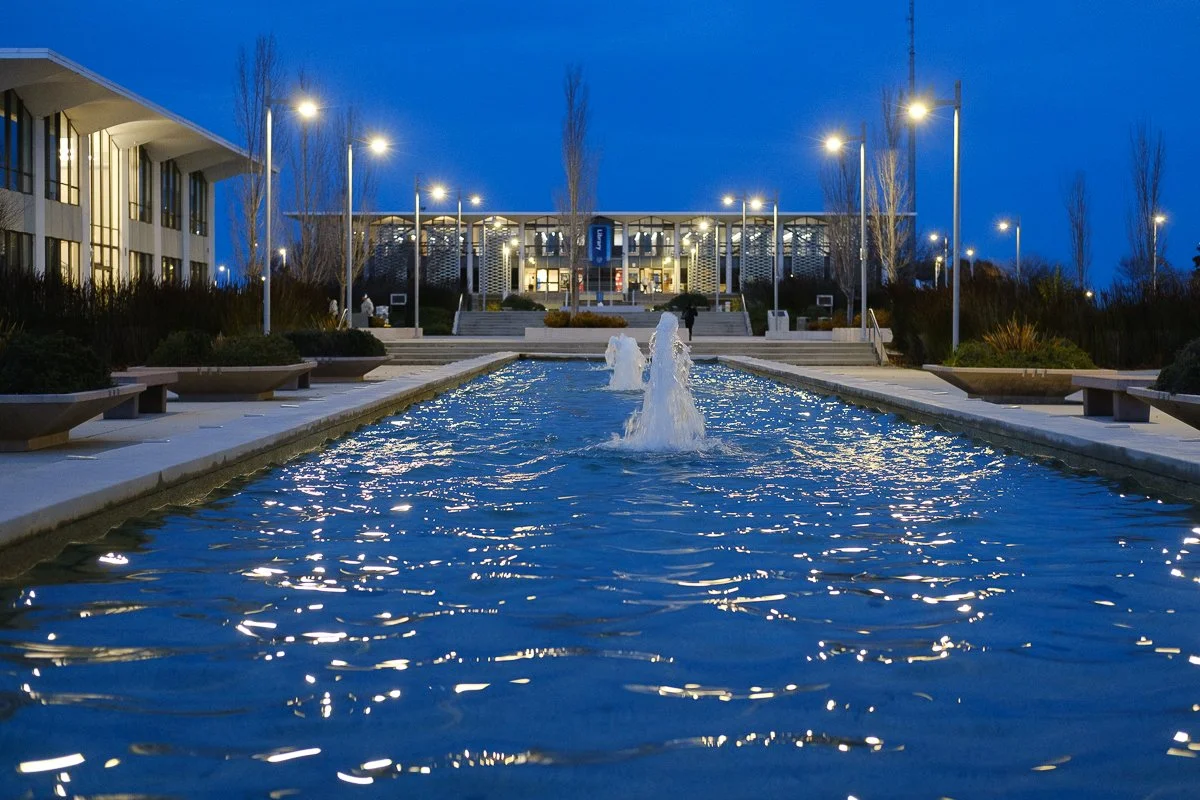
College of San Mateo Library (Building 10).
By Josh Weinberg. Text and original photographs are © 2026 by Josh Weinberg unless otherwise noted.
The Overlooked Modernist Campus Just South of San Francisco
The College of San Mateo’s College Heights Campus (CSM) is a Mid-Century Modern gem hiding in plain sight.
Designed in 1963 by the noted architect John Carl Warnecke, the campus is one of the most visitable and cohesive examples of Neo-Formalism in the Bay Area. Neo-Formalism, a Late Modernist interpretation of Classical architecture, emphasizes symmetry, columns and colonnades, arches, and a more ceremonial, monumental sense of form.
Note: While ‘New Formalism’ is more often used by architectural historians, I’ve chosen ‘Neo-Formalism’ here because it is the designation used in the college’s own historical and environmental surveys.
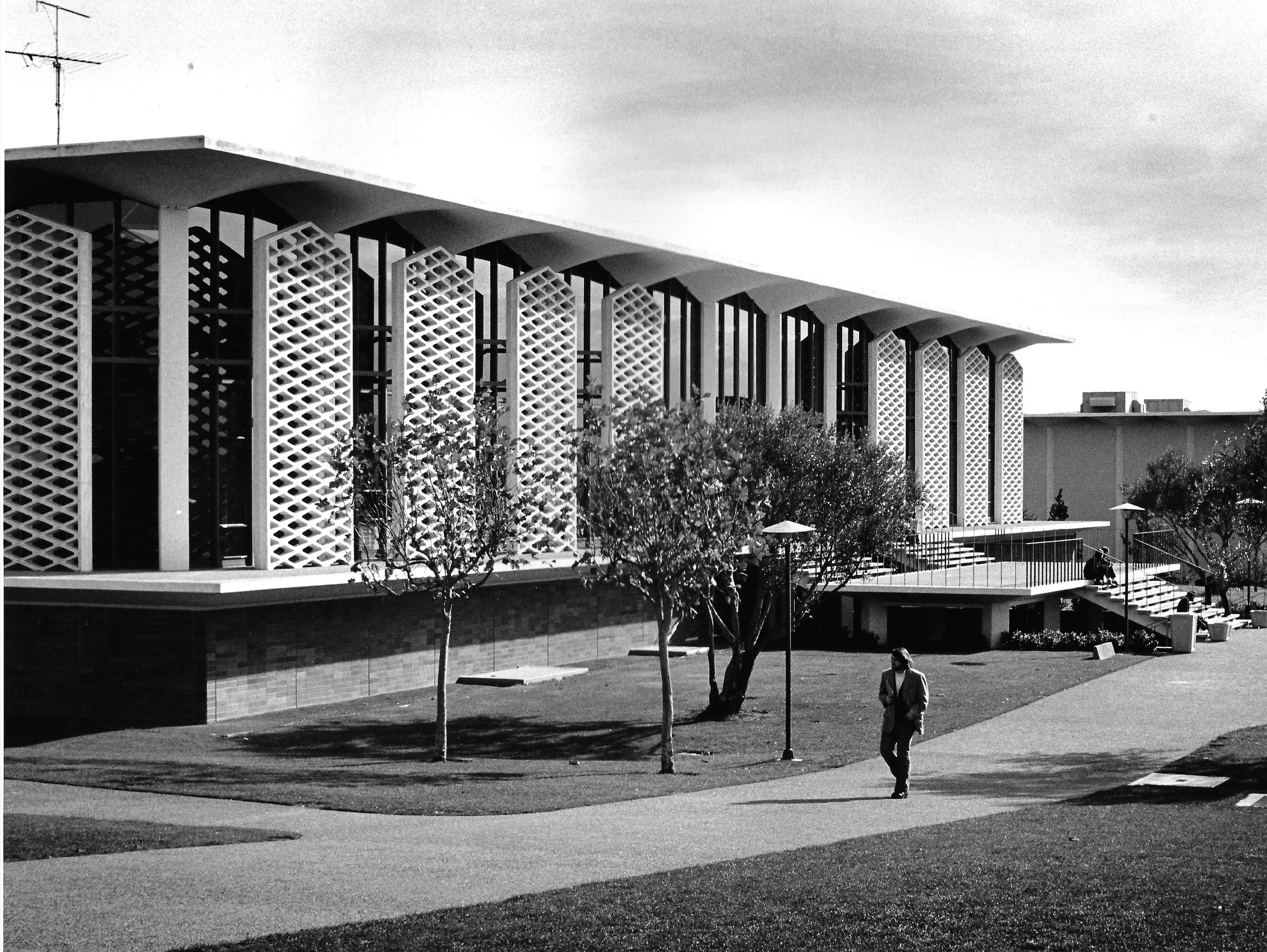
College of San Mateo Library. Photographer: Natalie Owings. Courtesy of Warnecke Architectural Archives.
The Library is the familiar landmark—the one building people tend to recognize—but the real surprise is how many of Warnecke’s original Neo-Formalist buildings remain, and how clearly his design intentions remain legible as you walk the campus. Even with the loss of several structures, the overall architectural approach remains largely intact.
Architectural historians have praised the campus, yet it remains under-recognized in Modernist architectural history.
Warnecke designed many iconic buildings, including the Hart Senate Office Building and the Hawaii State Capitol, but CSM rarely appears on his list of works. Warnecke spent much of his career in the Bay Area. Even so, the San Francisco Chronicle—the region’s largest newspaper—did not mention CSM when it published his 2010 obituary.
This is not really surprising, considering the college’s own website devotes only a single paragraph to the architecture, and the school has no dedicated architectural archives.
Yet, in the 2011 Historic Resources Technical Report for the College of San Mateo Fine Arts Building and associated campus buildings, architectural historian Dana E. Supernowicz concluded that the surviving early-1960s buildings at CSM “represent some of Warnecke’s finest achievements in Modern Eclectic architectural design,” and that the Fine Arts Complex, Library, and Administration Building exemplify Neo-Formalist principles and appear eligible as contributing elements to a historic district—constituting “an important regional example of Warnecke’s body of work.”
Recently, Dana E. Supernowicz, M.A., RPA, principal of Historic Resource Associates, said, “John Carl Warnecke is clearly one of the most significant architects in the Post-World War II era. The college and its association with Warnecke mark an important chapter in the history of institutional architecture in northern California and the transition from Classical forms of design to modern design.”
Others who are familiar with the campus also sing its praises. In November 2025, architectural writer and historian Heather David, author of Mid-Century by the Bay, wrote, “This is New Formalism at its best… There are pleasant surprises almost everywhere you turn.”
Why CSM’s Architecture is Often Overlooked
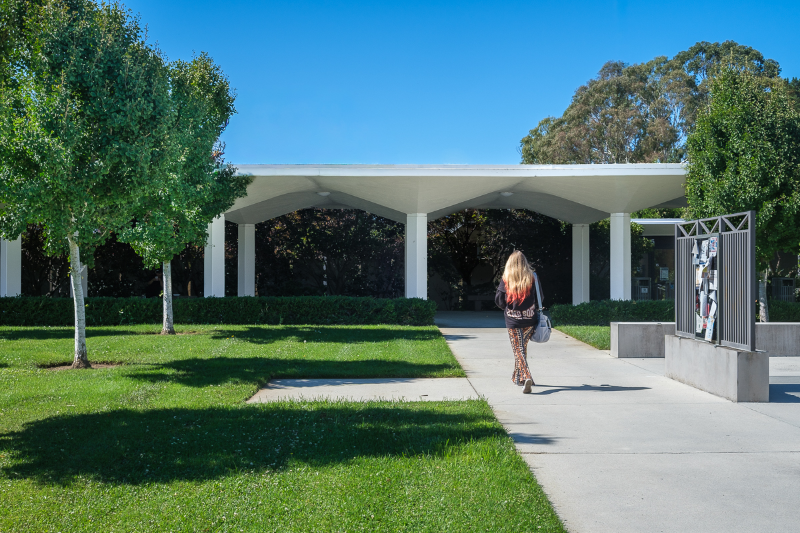
Covered Walkway at CSM Faculty Offices (Building 15).
The architecture at CSM has a way of blending into the surroundings—quietly shaping the place’s mood without demanding attention. The campus is beautiful, but not showy. This may be why the architecture seems to go unnoticed by the students, the previous school administrations, and the architectural community.
But, sixty-three years later, Warnecke’s design still exerts a silent, positive influence—shaping the campus experience for all who encounter it, often without them even realizing it. In other words, it just works.
The College of San Mateo deserves to be recognized, visited, and appreciated for what it is: a rare, cohesive, and delightful Neo-Formalist environment designed by a nationally significant architect, sitting right in the heart of the Bay Area.
College Heights Architectural Origins
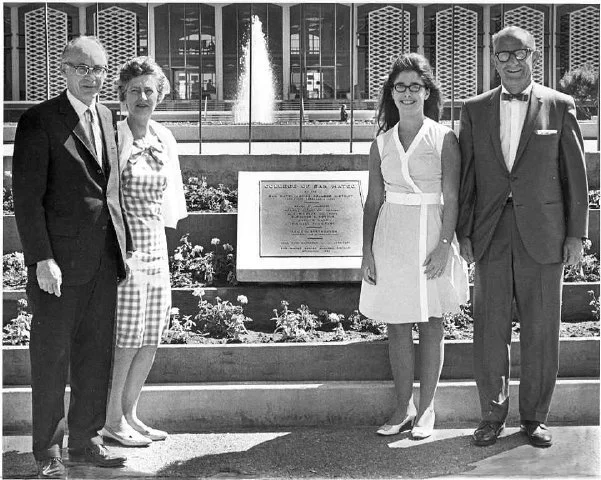
Julio Bortolazzo (right), President and Superintendent, College of San Mateo.
Photographer presumed to be: Isago Isao Tanaka. Courtesy of College of San Mateo Library Archives & Special Collections.
The story of College Heights begins with Superintendent Julio Bortolazzo, the driving force behind the creation of the new campus in the late 1950s. He believed a public junior college should feel like a true center of higher learning—a place that projected dignity, aspiration, and academic purpose. Architecture, he felt, was essential to elevating the institution.
To realize that idea, Bortolazzo turned to architect John Carl Warnecke, then emerging as one of the most thoughtful Modernist designers in the Bay Area.
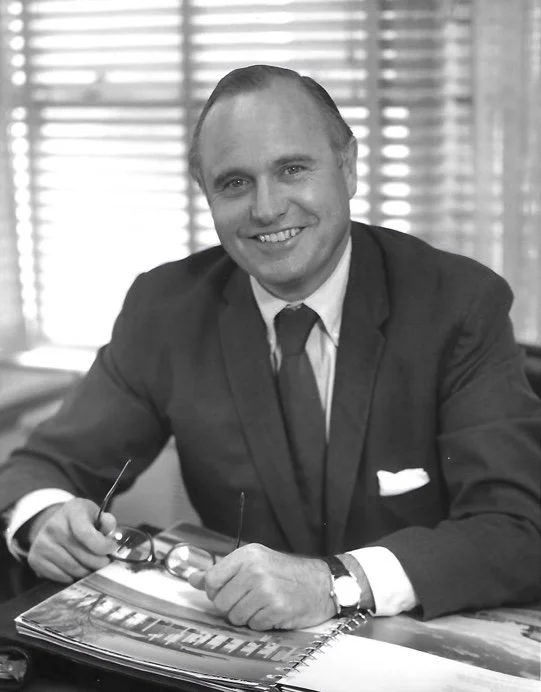
John Carl Warnecke. Courtesy of Warnecke Architectural Archives.
Warnecke was already known for a contextual approach to Modernism—shaping buildings in response to their site, climate, and purpose—as seen in early projects such as Mira Vista Elementary School (Richmond, CA), where he used light, orientation, and simple forms to create calm, functional learning environments. He believed architecture should express clarity, order, and civic purpose, and College Heights offered him the opportunity to apply those principles at the scale of an entire campus.
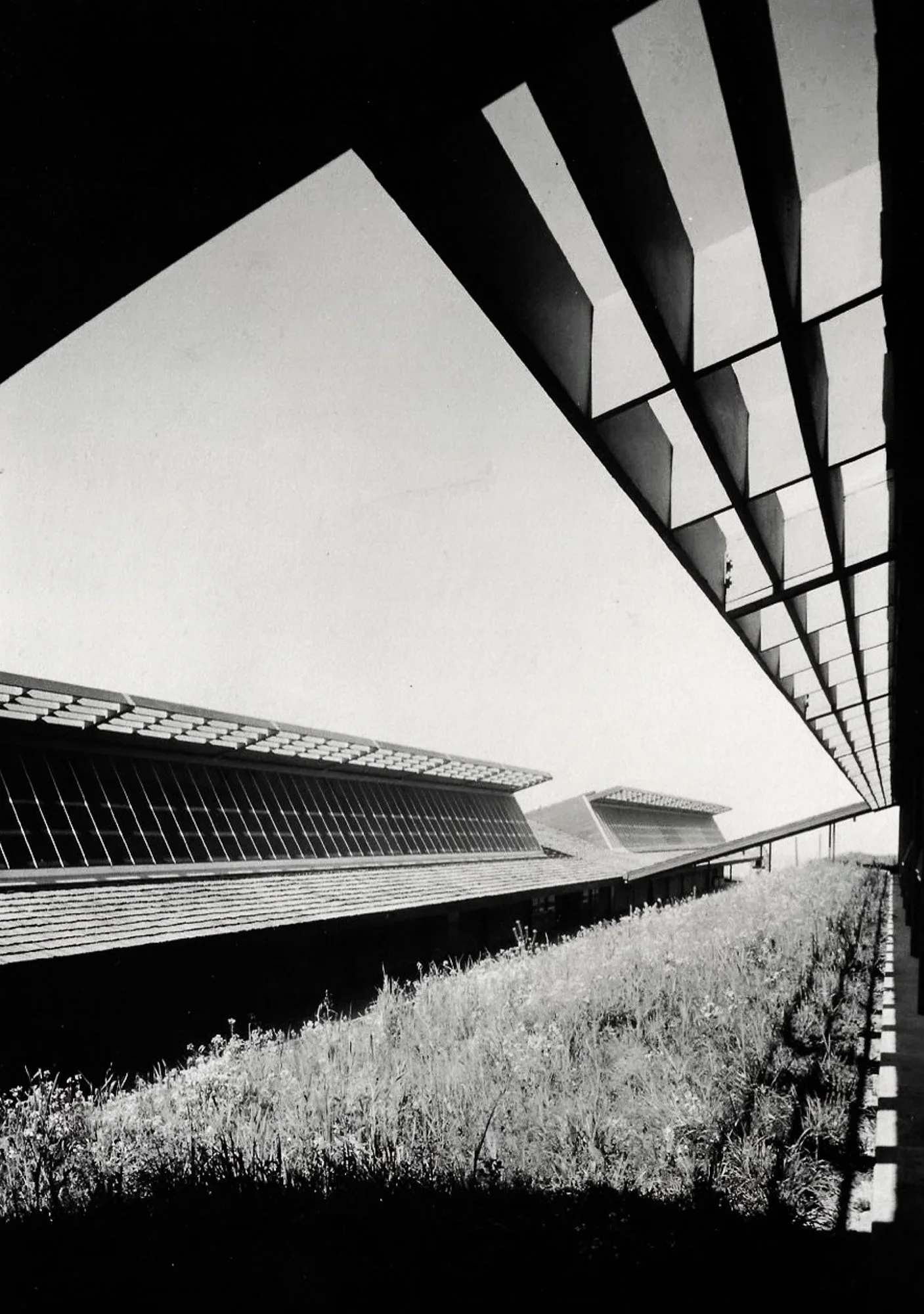
Mira Vista Elementary School, 6397 Hazel Ave. Richmond, CA 94805. Architect: John Carl Warnecke, 1951. Photographer: Rondal Partridge. Courtesy of Warnecke Architectural Archives.
Warnecke approached the College Heights campus project not as a series of isolated buildings but as a unified architectural environment.
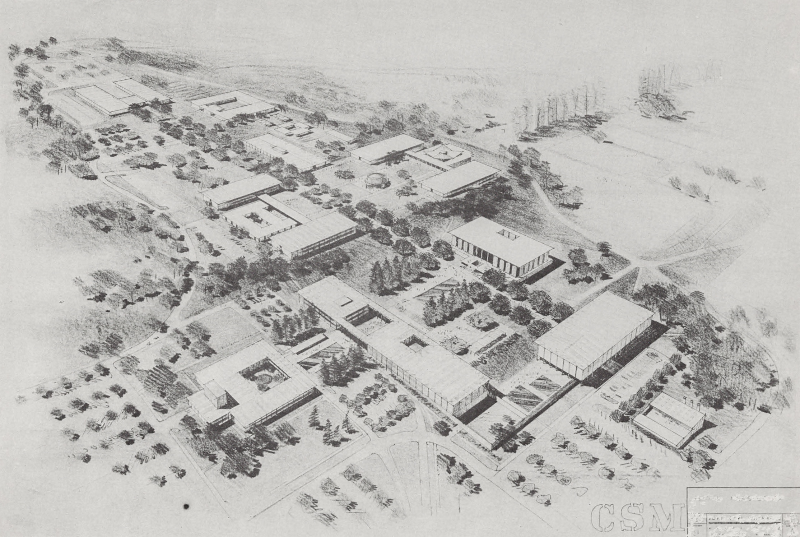
College of San Mateo Master Plan Drawing. Illustrator: Unknown. Courtesy of Warnecke Architectural Archives.
He embraced the emerging Neo-Formalism style—characterized by strong symmetries, clear axes, repeated structural modules, and sculptural concrete forms—to create a campus that felt both modern and ceremonial. Classical ideas re-entered Modernism here, not as historical imitation but as abstracted elements: colonnades, formal terraces, and carefully organized plazas. It was a modern language capable of conveying dignity and presence.
One of the earliest and most influential examples of this style was Edward Durell Stone’s U.S. Embassy in New Delhi, India (1954), whose disciplined symmetry, delicately patterned screens, and interplay of modern materials with classical order helped define the new style.
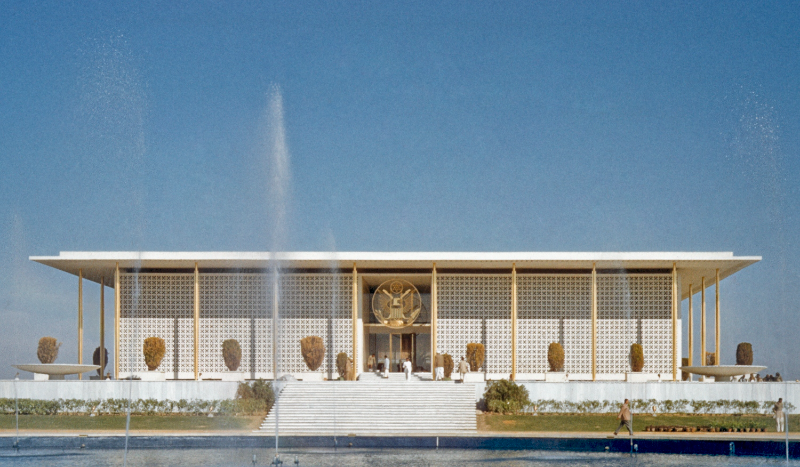
United States Embassy in New Delhi, India. Architect: Edward Durell Stone, 1954. Photographer: Unknown. Source: Wikipedia CC BY-SA 4.0.
Stone’s approach helped set the tone for Warnecke’s own work at College Heights—particularly in the design of the Library, where vertical rhythm, deep eaves, and patterned concrete screens create a sense of academic gravitas.
Across the post-World War II United States, architects were rethinking what a modern campus should be—coherent, dignified, and shaped by rhythm and procession. Warnecke was part of this movement and studied earlier models such as Frank Lloyd Wright’s 1940s campus at Florida Southern College (Lakeland, Florida) and Minoru Yamasaki’s 1957-1965 Neo-Formalist work at Wayne State University (Detroit, Michigan).
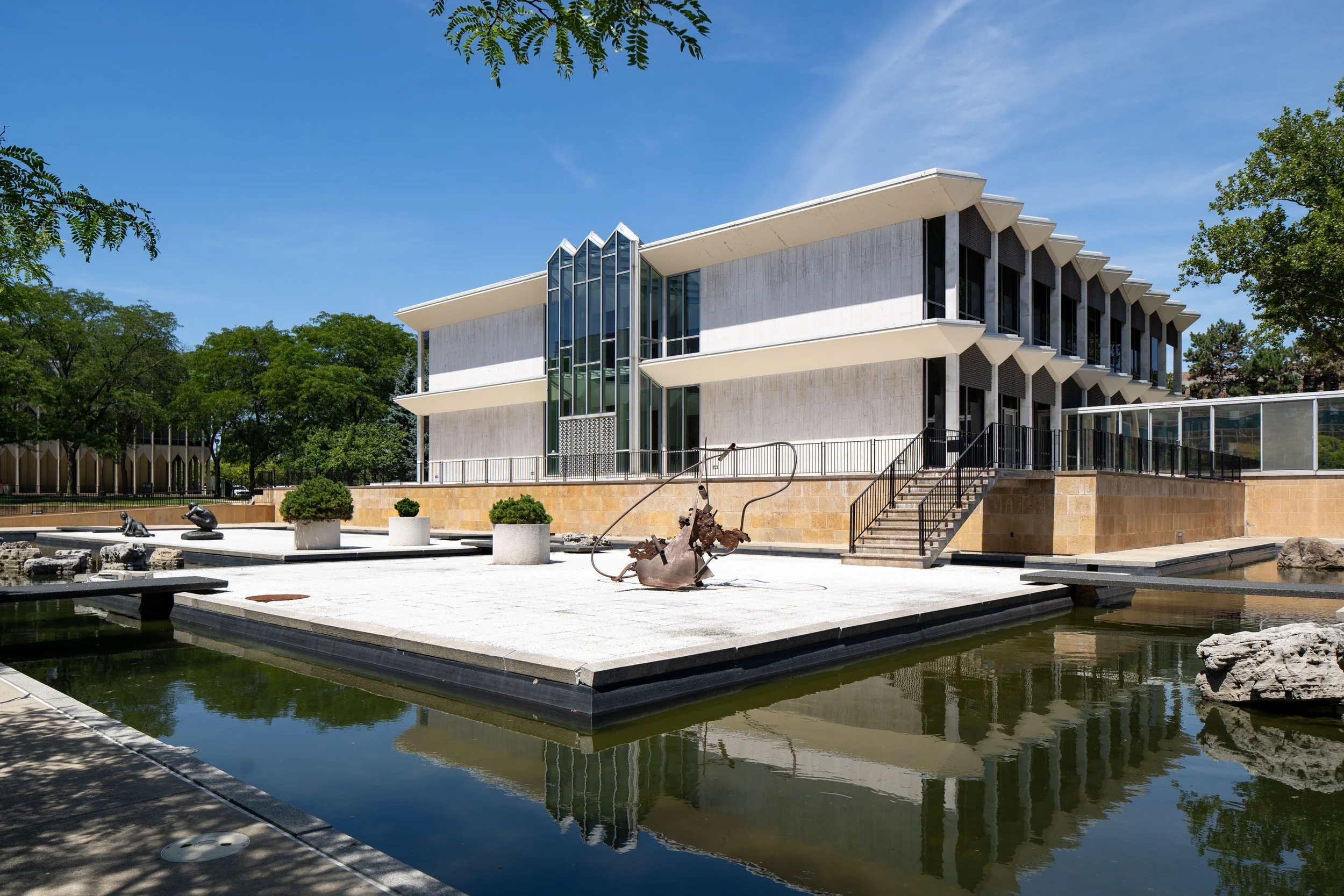
McGregor Memorial Conference Center, Wayne State University, Detroit, Michigan. Architect: Minoru Yamasaki, 1958. Photographer: Barrett Reiter.
These influences converged at College Heights, where Warnecke produced one of the most fully realized expressions of Neo-Formalism on a West Coast campus, giving architectural form to the institution's academic purpose.
Bortolazzo and Warnecke succeeded. As Michael Svanevik wrote in Class Act: College of San Mateo: A History, “Architectural critics cackled with obvious admiration” and “Many felt that it was among the first two-year colleges in the nation to express the dignity of a university.”
Campus Planning and the Natural Environment
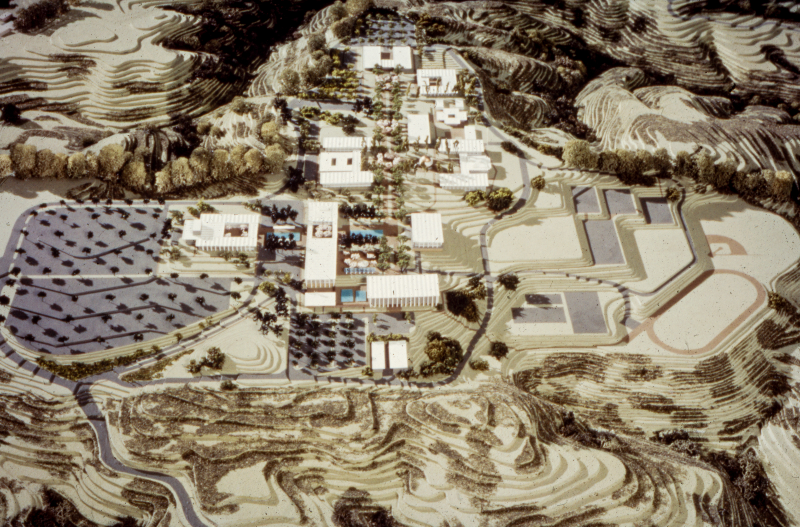
Architectural Model of College of San Mateo. Courtesy of Warnecke Architectural Archives.
Warnecke began by shaping the land itself. Guided by Bortolazzo’s vision for a dignified, university-like campus, he undertook a rigorous planning process—complete with wind studies, view analyses, acoustic consultants, and careful terracing—to ensure the site would function as a coherent, comfortable environment. These planning strategies—wind protection, terraced siting, sheltered courtyards, and the careful separation of vehicles from pedestrians—set the physical framework for the campus. They ensured that College Heights would function as a comfortable, walkable environment despite its exposed hilltop location.
Designing for Wind, Views, and Topography
Warnecke’s architectural vision for College Heights was inseparable from the way the campus was shaped by its hilltop setting. The goal was not only to place buildings but also to create an environment that responded to the peninsula’s exposure to strong seasonal winds and panoramic views. Warnecke placed the physical education courts and athletic fields on the east side of the site, stepping them down the hillside—sometimes by as much as 100 feet below the crest—to shield them from prevailing winds. In contrast, the academic terraces were positioned to take advantage of light and views while benefiting from the natural windbreak provided by the slope and building massings. Although the campus is Neo-Formalist in style, Warnecke’s attention to wind, slope, and views also reflects his ties to the broader Bay Tradition, with its emphasis on architecture shaped by site and climate.
The highest plateaus were reserved for the major buildings, including the Library. Parking for more than 2,300 cars was placed on the west and lower edges of the site, ensuring that once students stepped onto campus, they would move through a pedestrian landscape uninterrupted by roads.
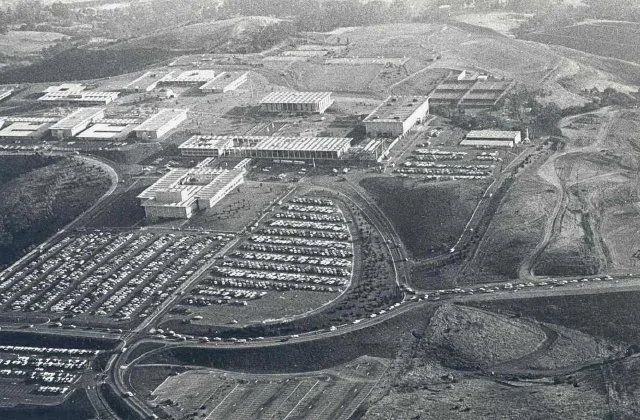
College of San Mateo “Aerial view of new campus in 1963-1964” Courtesy of College of San Mateo Library Archives & Special Collections.
The Design Language of College Heights
The repeating elements of Warnecke’s design establish a consistent architectural rhythm and help form the visually cohesive campus core.
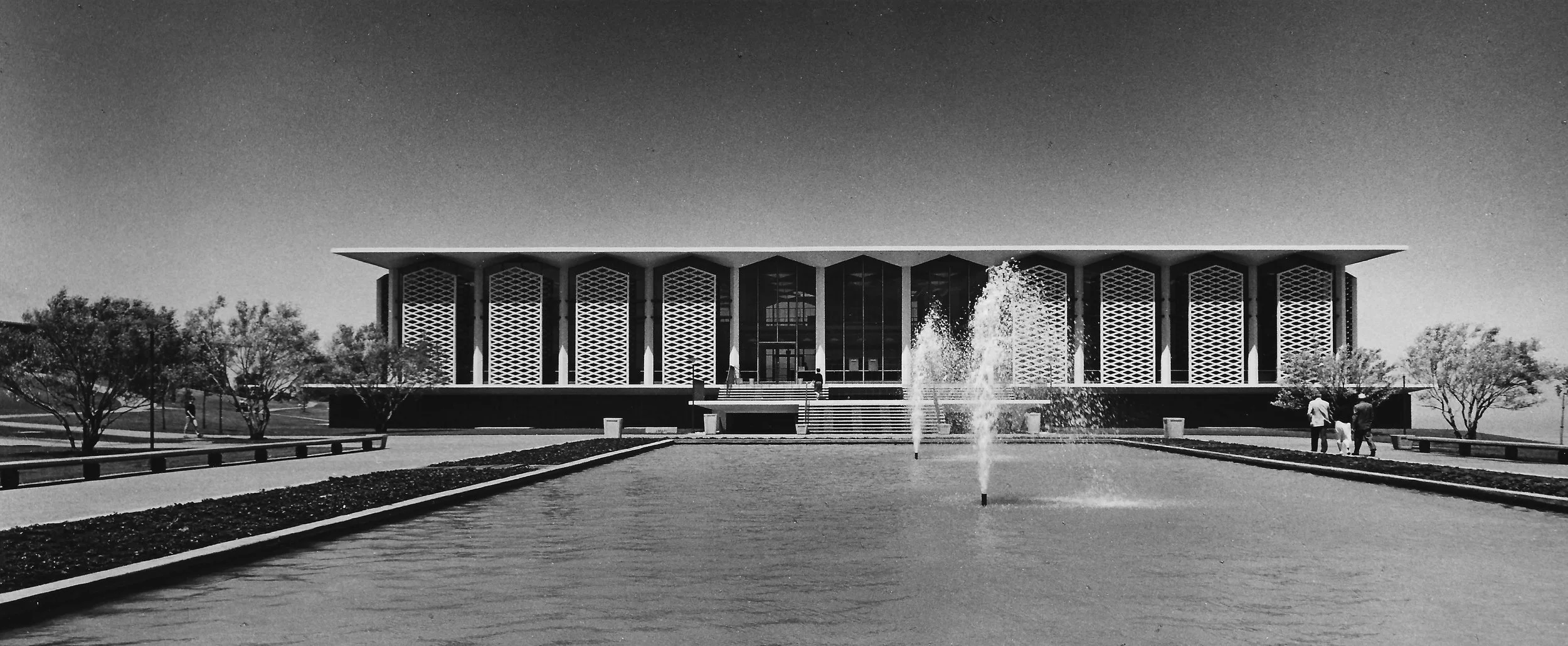
College of San Mateo Library and Fountain. Photographer: Gerald Ratto. Courtesy of Warnecke Architectural Archives.
Roofs: Hyperbolic Parabolas or Folded-Plate Roofs
Many of the buildings use hyperbolic paraboloid roof slabs—also called folded-plate roofs—which, when combined with the facade rhythm discussed below, create a distinctive design motif.
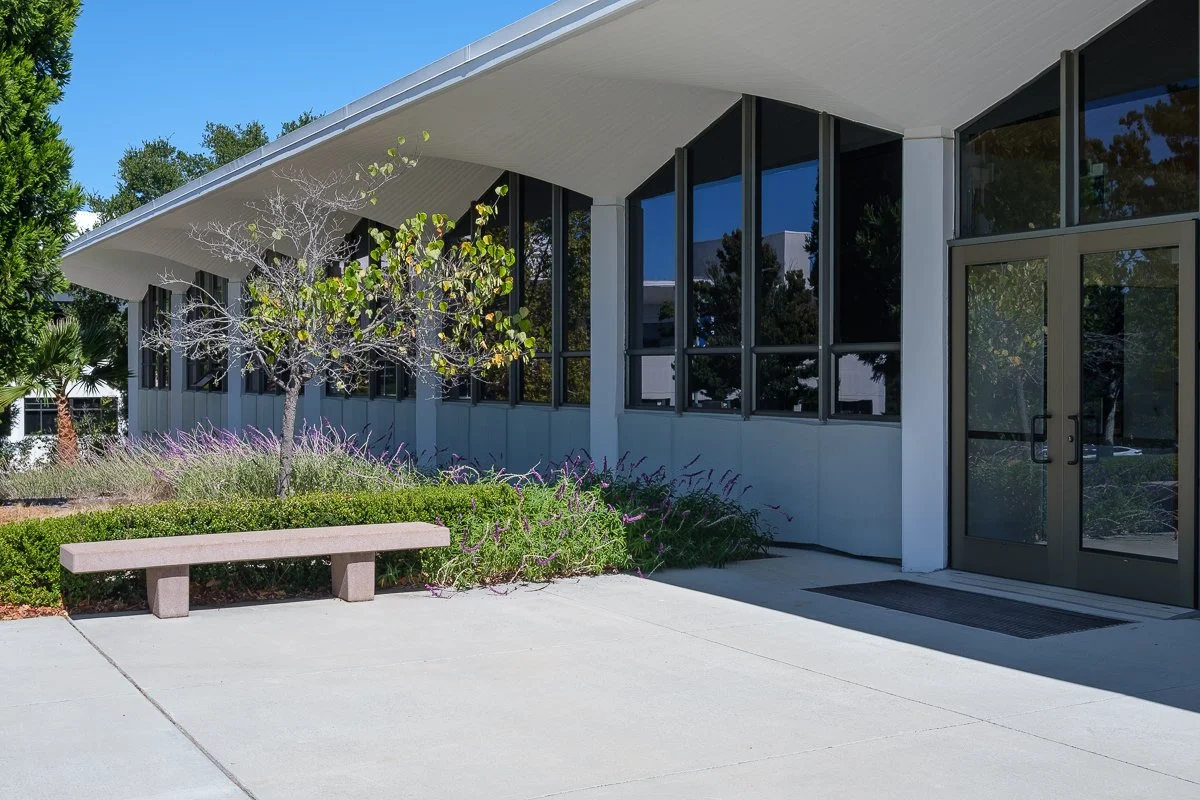
College of San Mateo Emerging Technologies (Building 19) — originally Engineering/Electronics.
Bays, Columns, and the Rhythm of the Facades
One of the most recognizable features is the way tall, narrow concrete columns divide each façade into repeating bays, a pattern that appears in nearly all surviving Warnecke buildings.
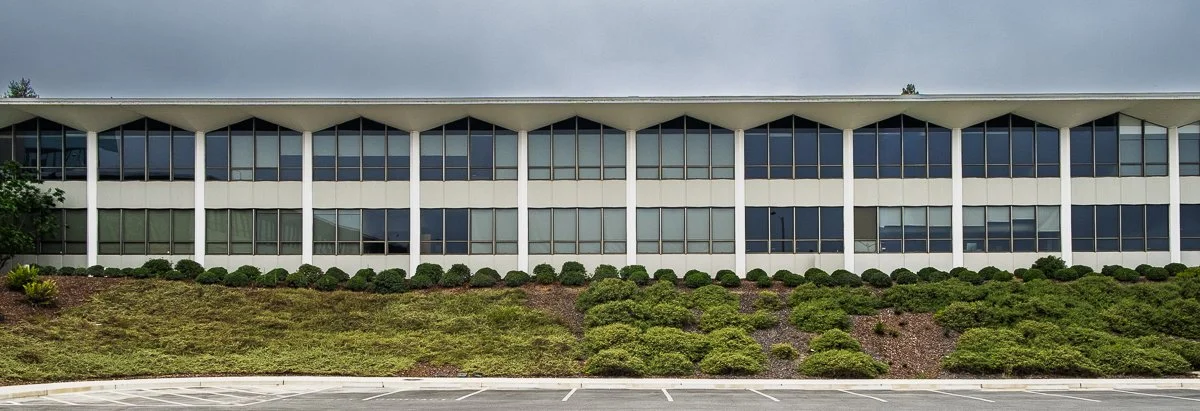
Rear of Emerging Technologies (Building 19) — originally Engineering/Electronics.
These bays are capped by distinctive triangular panels created where the hyperbolic-paraboloid or folded-plate roof units meet the glass.
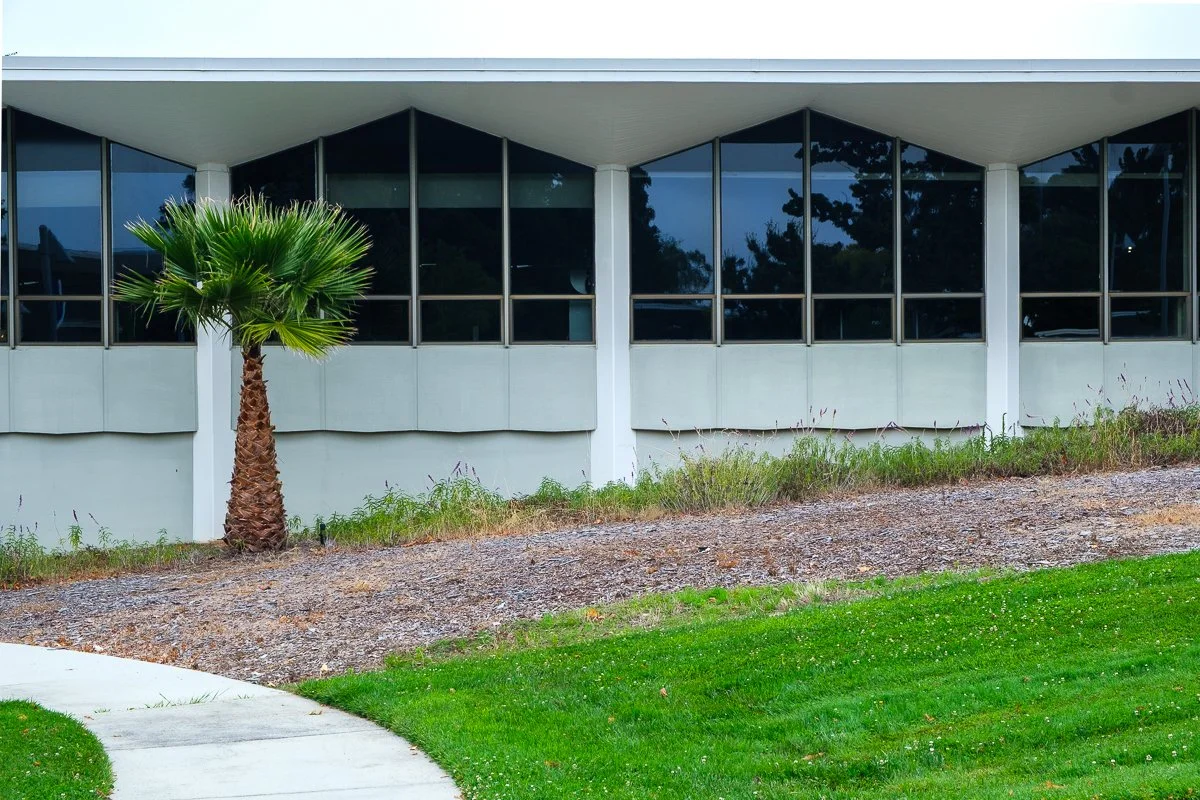
College of San Mateo Emerging Technologies (Building 19) — originally Engineering/Electronics.
The same bay module appears on both one-story structures and multi-story buildings, giving the campus a consistent scale and visual rhythm.
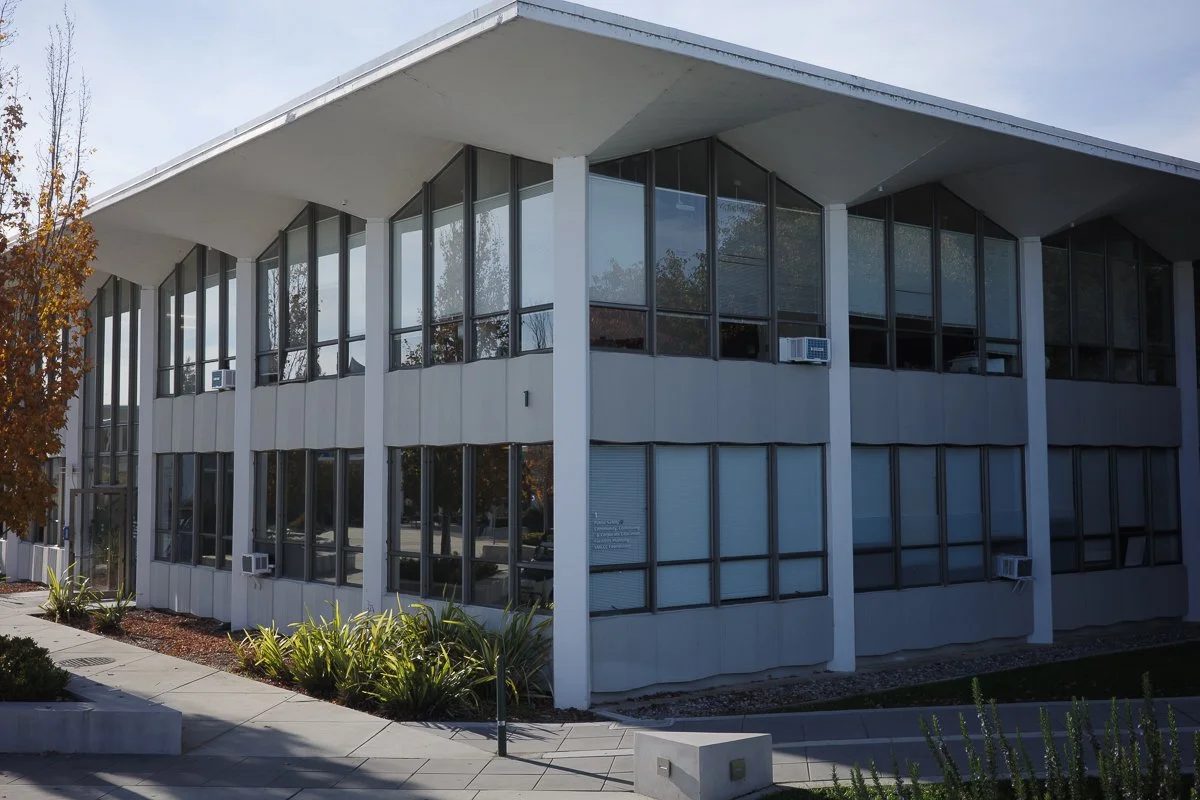
College of San Mateo Public Safety & Medical Services Building (Building 1) — originally Administration.
The deep projecting eaves formed by these roof units reinforce the bay structure and create a continuous upper edge across buildings of different sizes and functions.
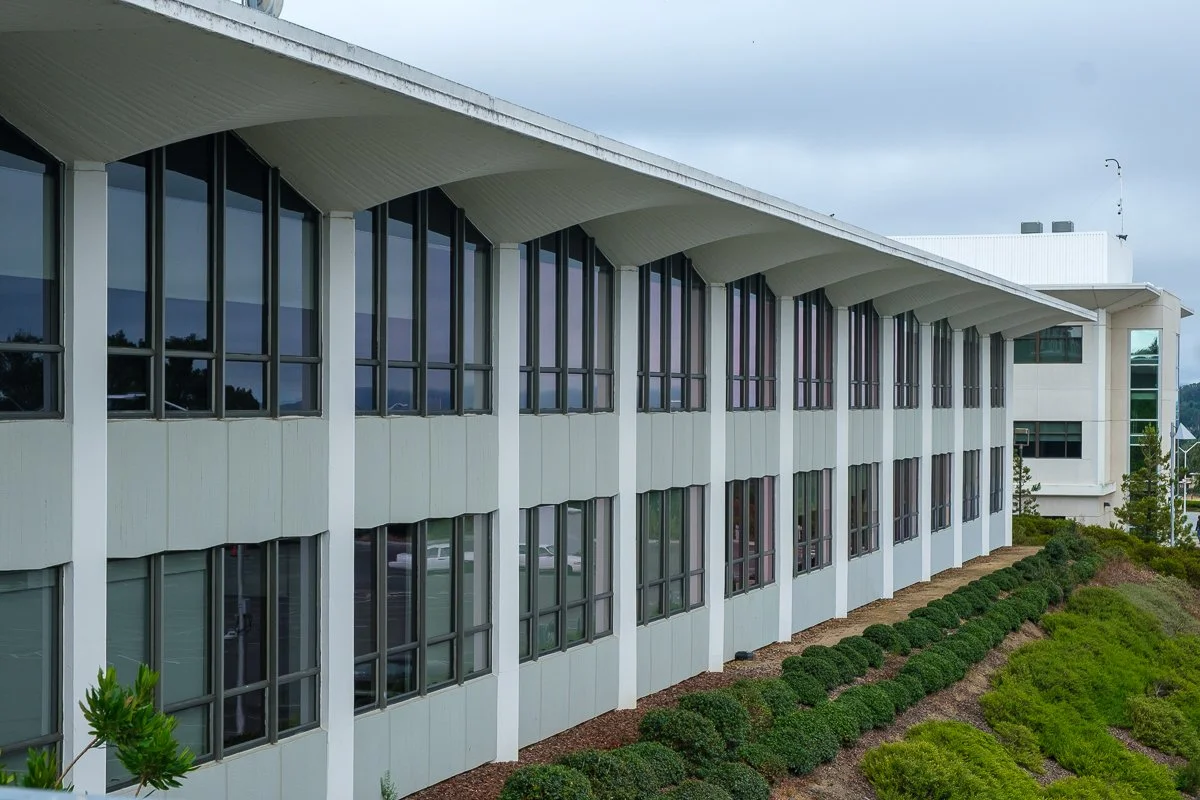
College of San Mateo Emerging Technologies (Building 19) — originally Engineering/Electronics.
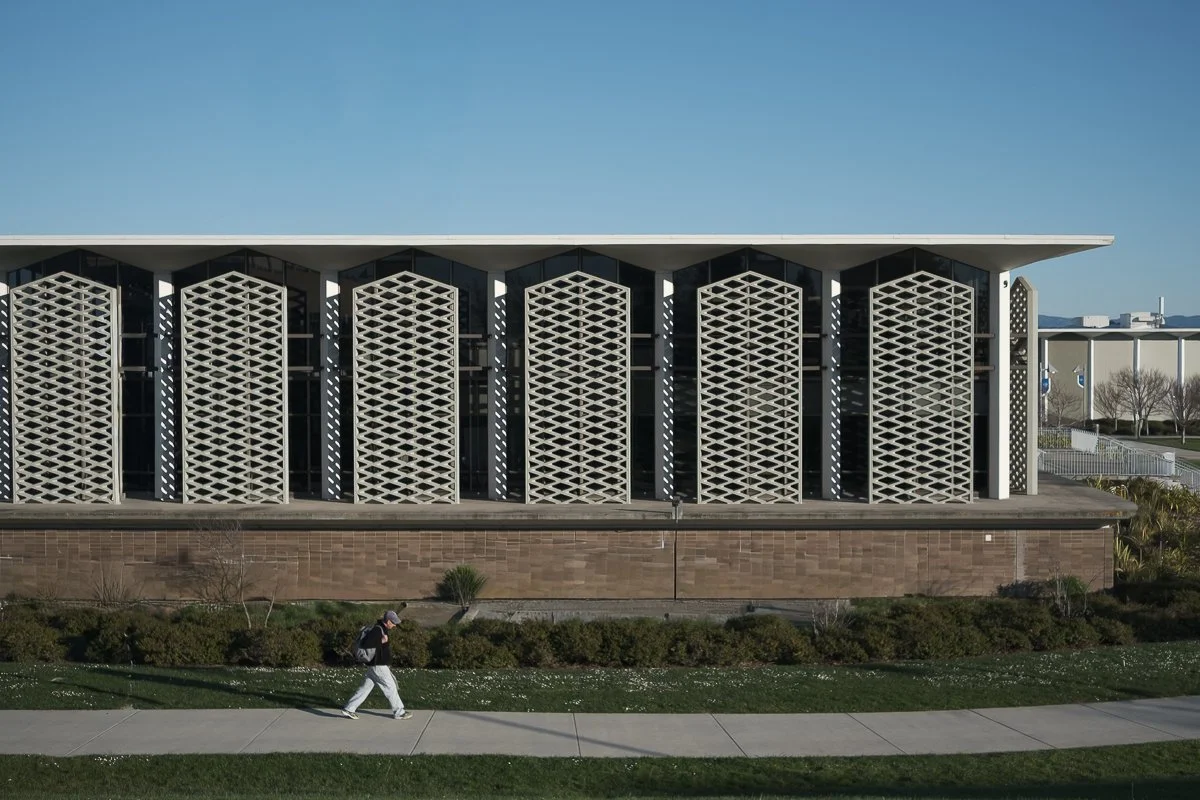
College of San Mateo Library (Building 10) North Facade.
Sixteen-Foot Modules
As these repeated elements begin to accumulate—folded-plate roofs, pointed-arch windows, narrow concrete columns, and recurring bays—an underlying order starts to emerge. The buildings are organized in what the architect called “strongly expressed” 16-foot modules, and while the details vary from one building to another, the width remains the same. These repeated modules are one of the things that give the campus its visual coherence. It helps make the architecture feel calm, balanced, and easy to read, while reinforcing the larger ambition to feel dignified and collegiate.
There are many versions of these modules, so the campus never seems boring or repetitive.
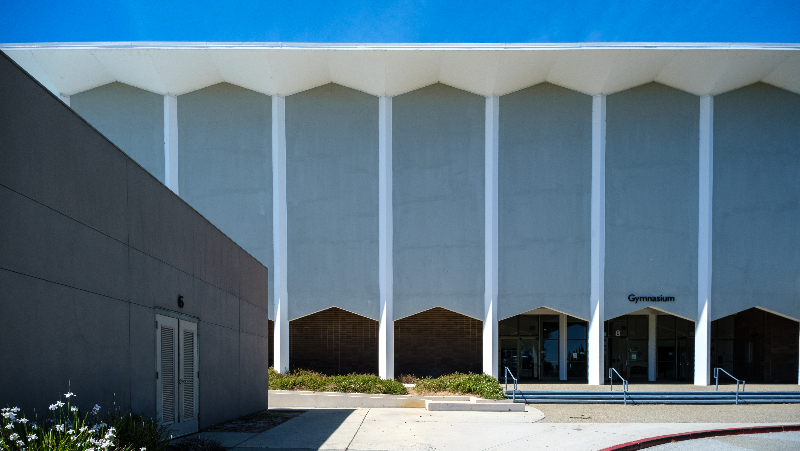
College of San Mateo Gymnasium (Building 8) Rear Entrance.
Covered Walkways and Colonnades
Covered walkways and colonnades link many of the campus buildings and shape its courts, plazas, and outdoor rooms. Supported by rows of concrete columns and organized by the same repeating 16-foot module, they extend the campus’s structural rhythm into its pedestrian routes and outdoor spaces. These help unify the campus and reinforce the dignified, collegiate atmosphere Warnecke and the Bortolazzo deliberately sought.
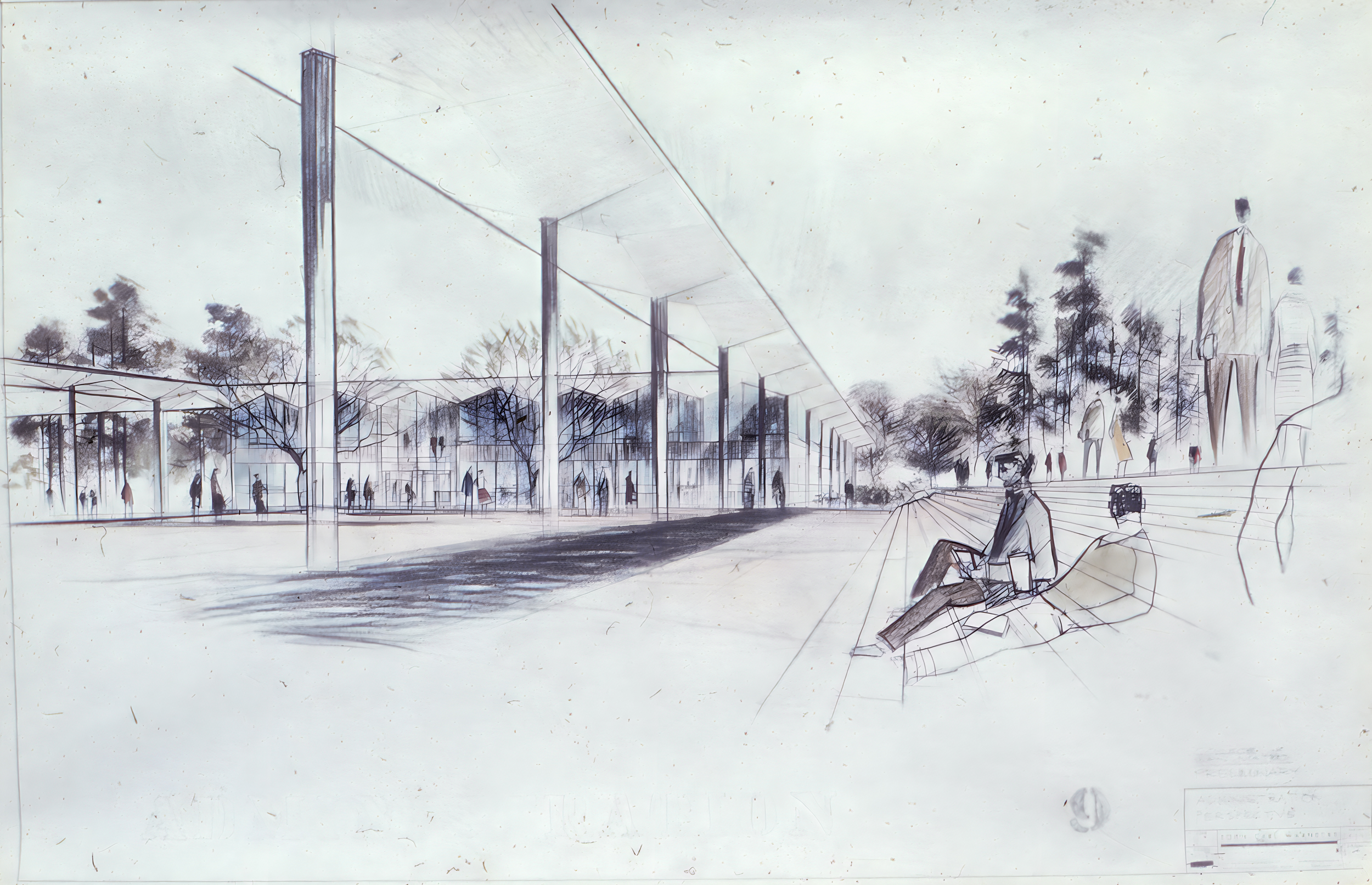
Preliminary rendering of the colonnades at the College of San Mateo linking the Student Center (Building 5) to Administration (Building 1). The colonnades and the Student Center were later removed to make way for the new Health and Wellness Building. Illustrator: unknown. Courtesy of Warnecke Architectural Archives.
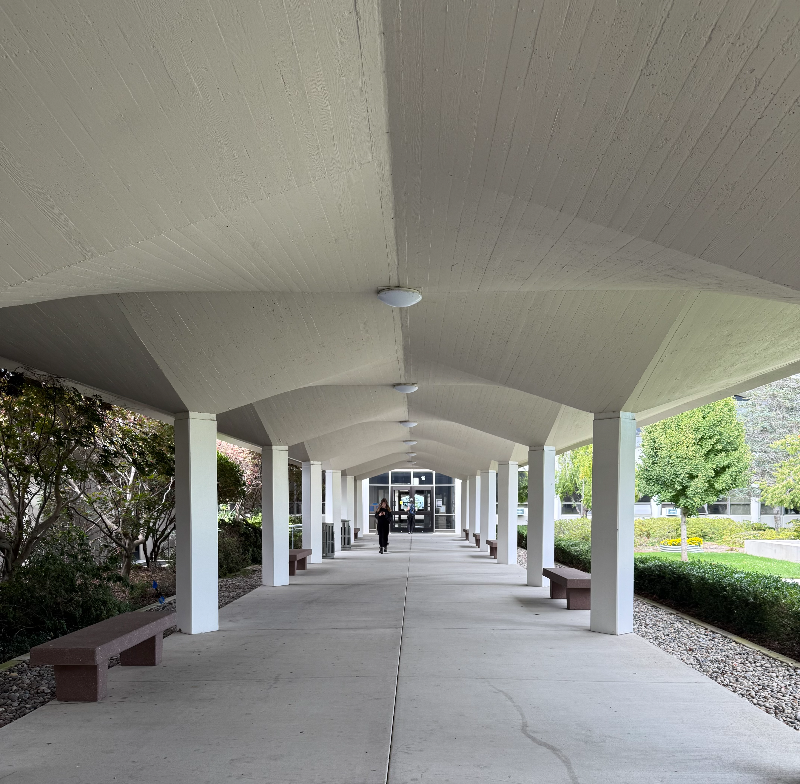
Covered walkway at the College of San Mateo connecting South Hall (building 14) to Central Hall (building 16). Photographer: Heather David. Used with Permission.
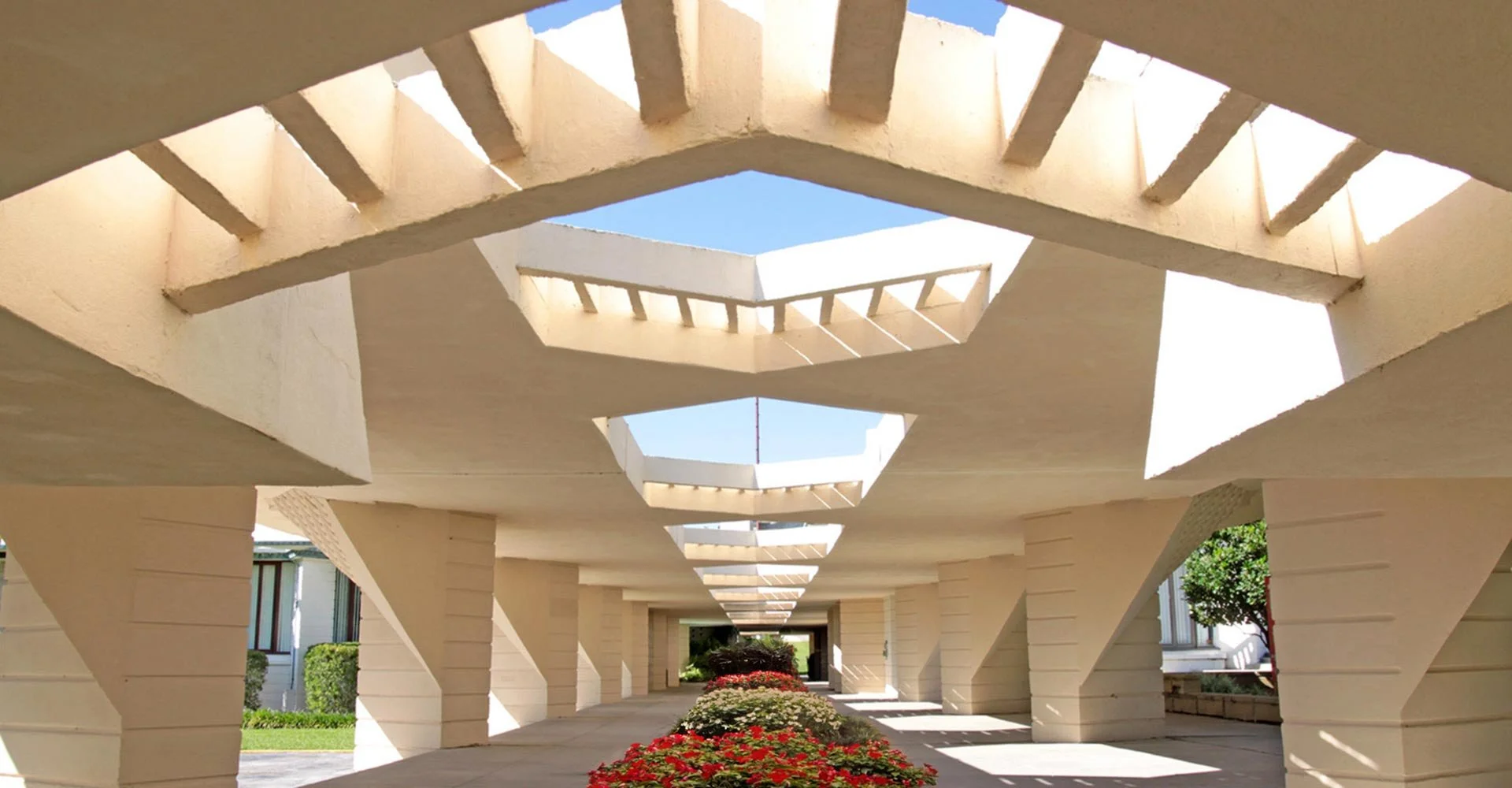
Covered esplanade at Frank Lloyd Wright’s Florida Southern College, Lakeland, Florida. Warnecke studied Florida Southern while developing the College of San Mateo. Photographer: unknown. Source: Florida Southern College.
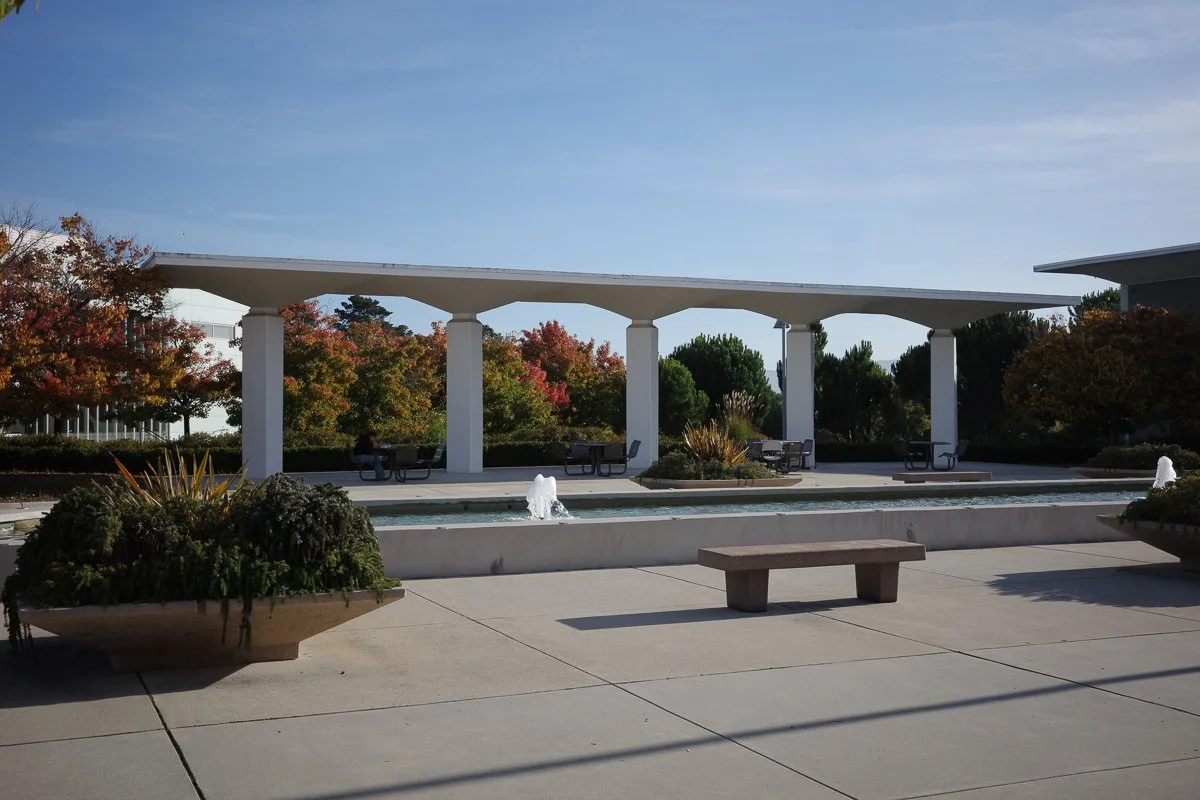
Colonnade at the College of San Mateo between the Fine Arts Complex (buildings 2, 3, & 4) and Public Safety & Medical Services Building (building 1) — originally Administration.
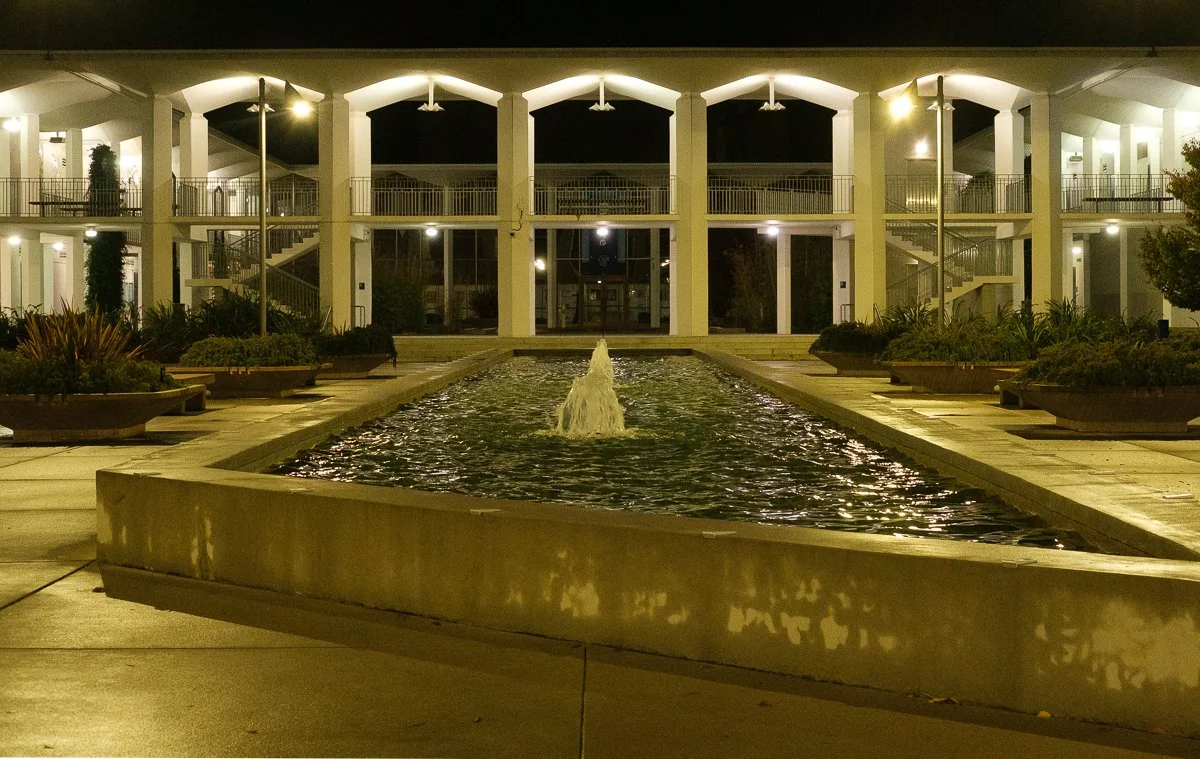
Two-story covered walkway at College of San Mateo connecting the Music (building 2) and Art (building 4) at the Fine Arts Complex.
Outdoor Rooms
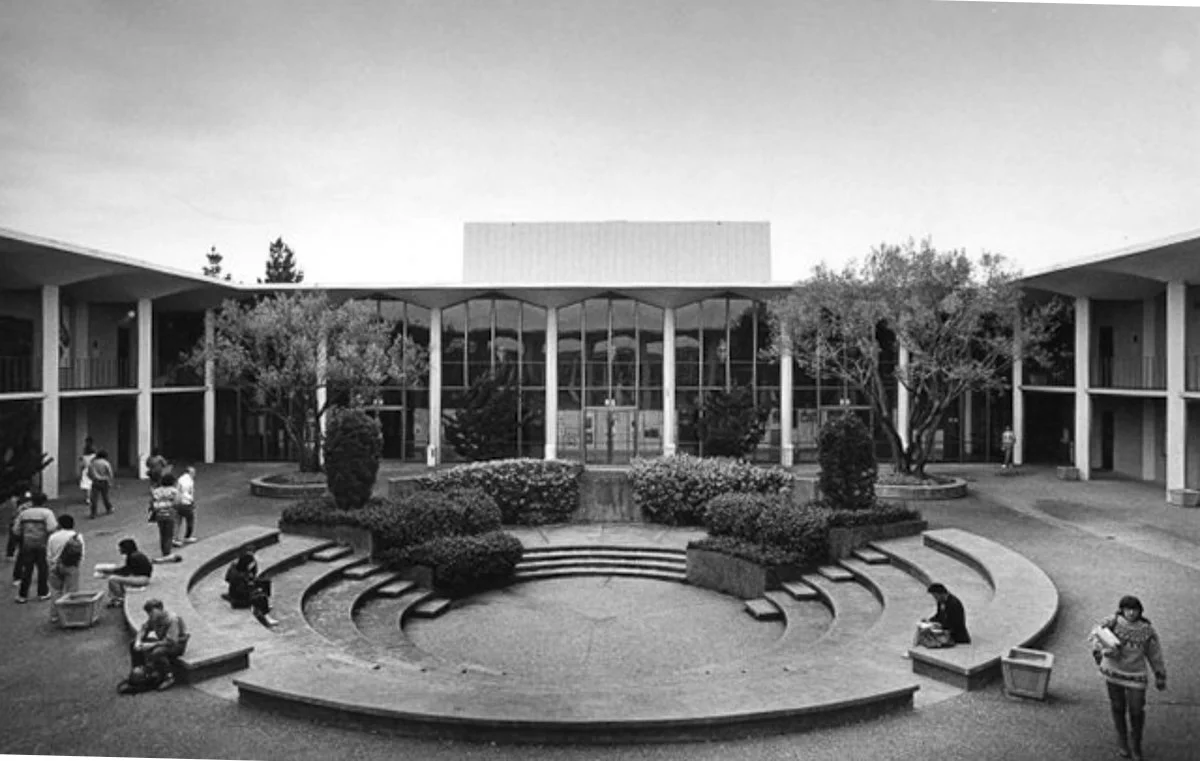
Many of the buildings were organized around courtyards for wind protection. These choices reinforced Warnecke’s Neo-Formalist architectural language while ensuring that the campus would be usable year-round. Secondary malls and plazas were oriented to create sheltered outdoor rooms, as evidenced by the Fine Arts Center.
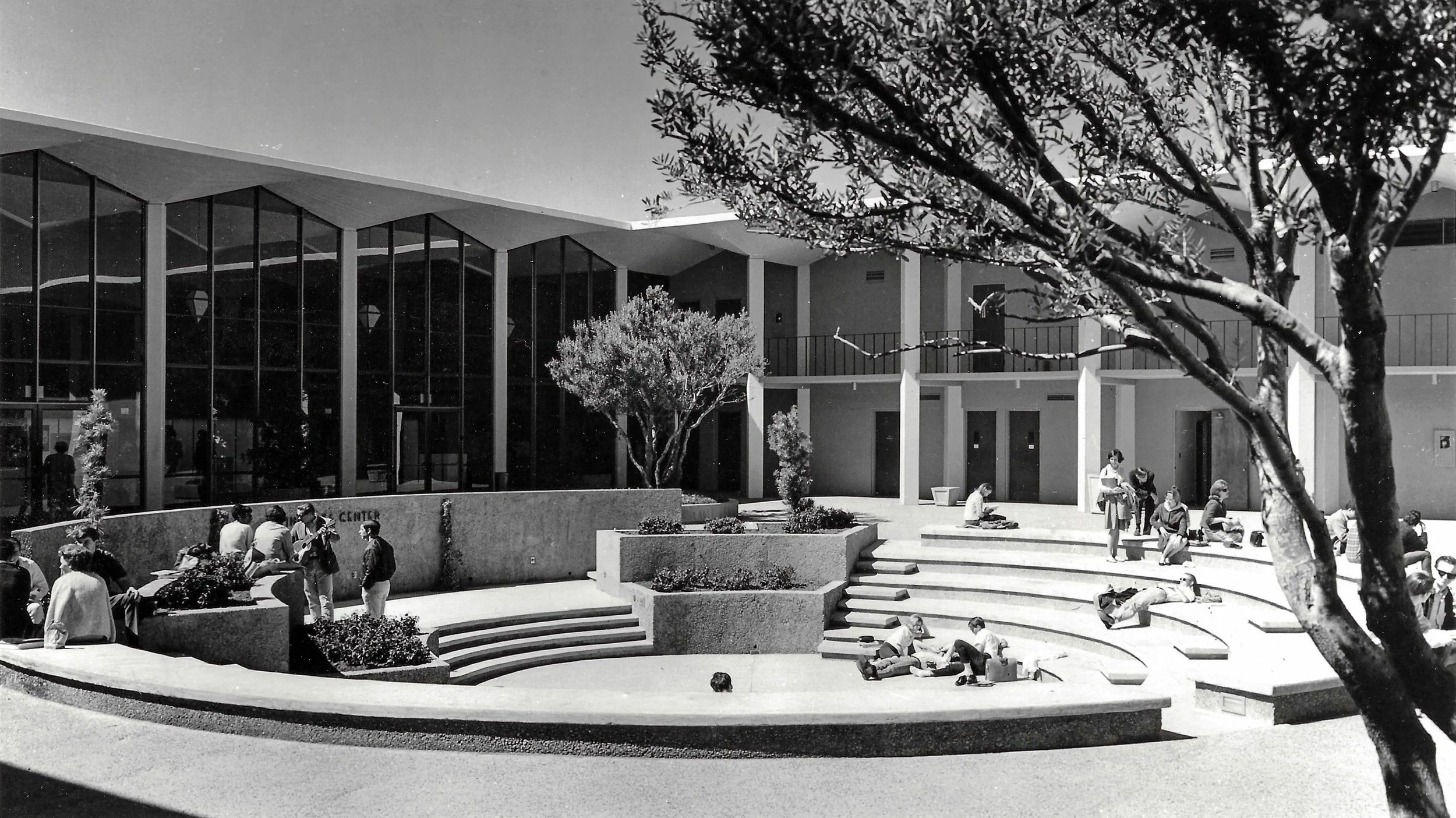
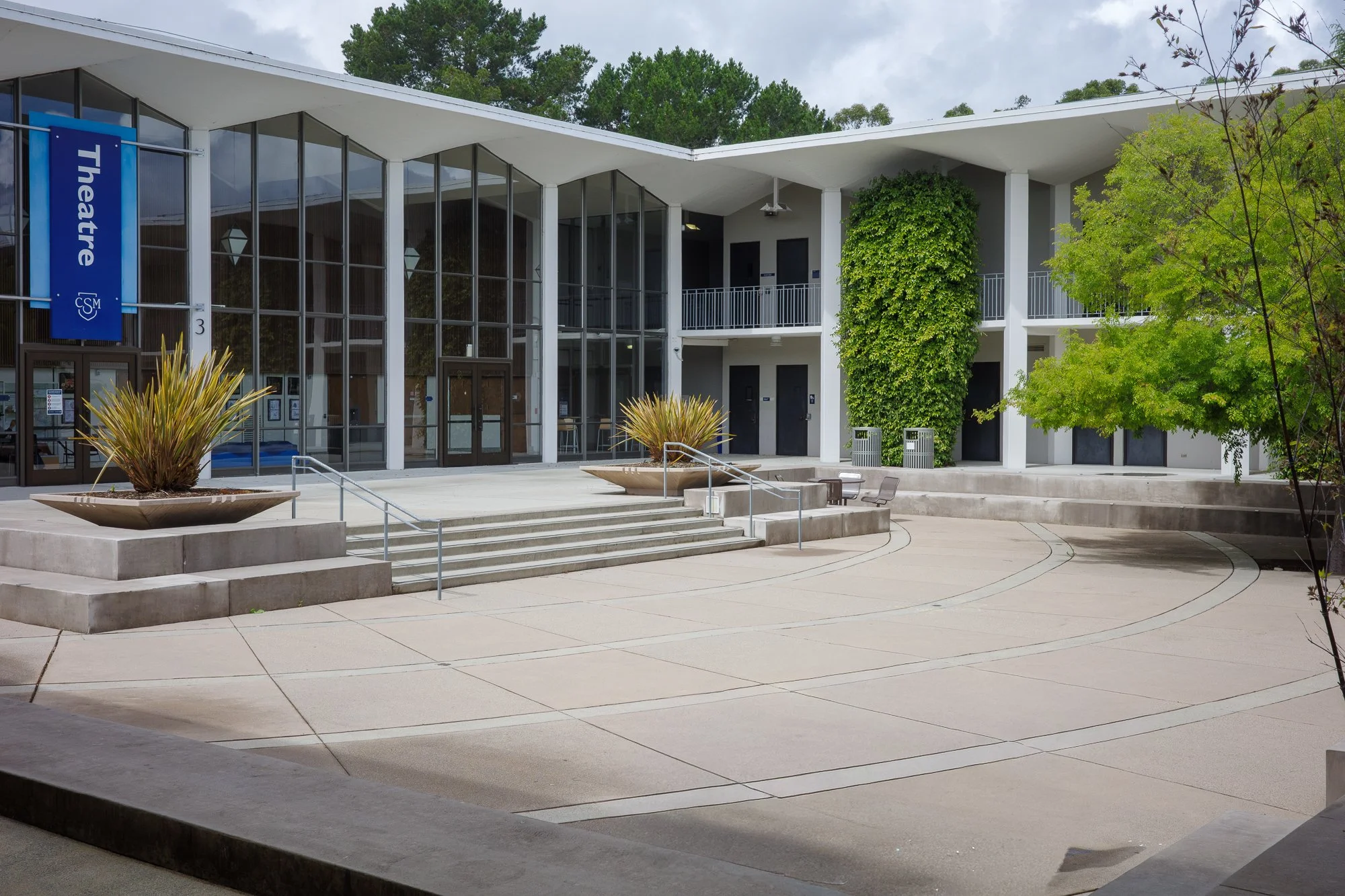
L: College of San Mateo Fine Arts Complex outdoor amphitheater.
R: The amphitheater was removed during accessibility updates.
1963 Photographer: Joshua Freiwald. Courtesy of Warnecke Architectural Archives.
Entryways and Multi-Story Glass Bays
At several of the campus’s most important buildings, Warnecke uses multi-story glass bays to mark entrances and emphasize their importance. At the former Administration building, Gymnasium, Theater, and Library, these tall glazed bays interrupt the regular rhythm of the facades just enough to draw the eye and highlight the entrance. In several of these buildings, the roof angles and triangular tops of the windows continue inside as folded or angled ceilings.
Warnecke varied the number of these full-height glass bays from building to building. The Administration building has one; the Gymnasium has three; the Theater has seven, stretching across the entire front; and the Library extends the motif the most, with eleven bays across its main facade and many more wrapping around the entire building. The effect is not only visual variety but also hierarchy: the full-height bays are used most extensively on the buildings that Warnecke saw as the school’s key program elements, especially the Library, which he described as the focal point of the campus.
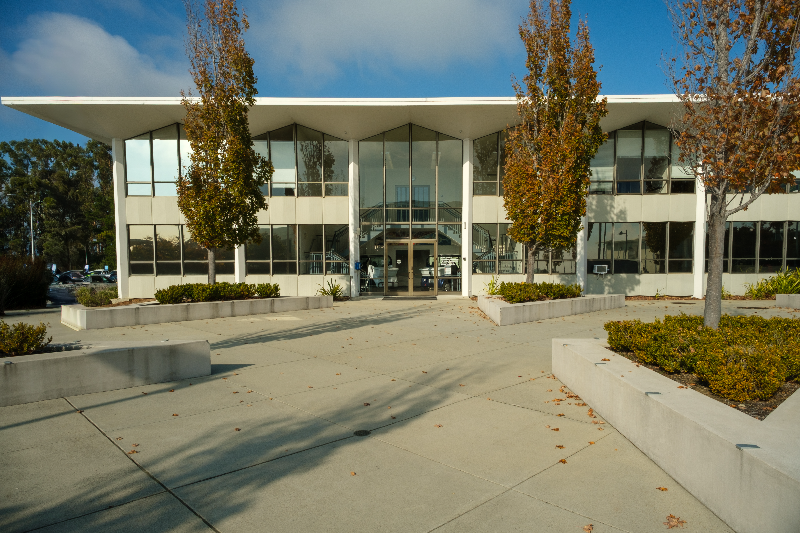
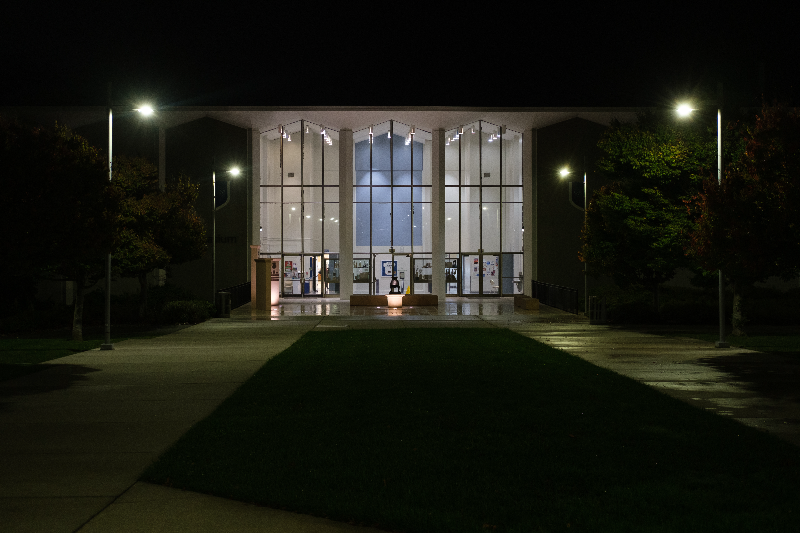
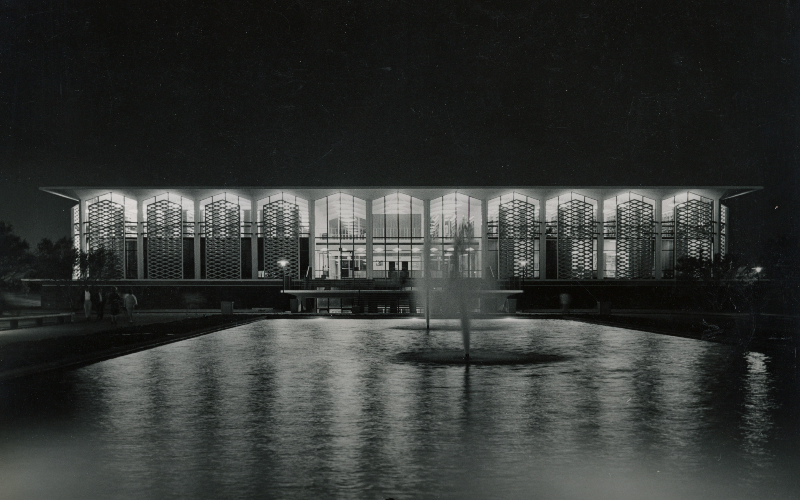
One, three, seven, and eleven multi-story glass bay fronts as seen on buildings 1, 8, 3, and 10.
Library Photographer: Ernest Braun. Courtesy of Warnecke Architectural Archives.
Fine Arts Photographer: Presumed to be Isago Isao Tanaka. Courtesy of College of San Mateo Library Archives & Special Collections.
Library ScreenS
One of the Library’s most distinctive features is its pierced concrete screening, which wraps much of the building and gives it a richer, more ceremonial presence than a simple glass box would. The screens are both decorative and functional: they create depth and visual texture on the facade while also filtering direct sunlight and glare through the large glass walls behind them. They are a good example of how Warnecke’s contextual architecture at College Heights combines sculptural effect with practical response to the environment.
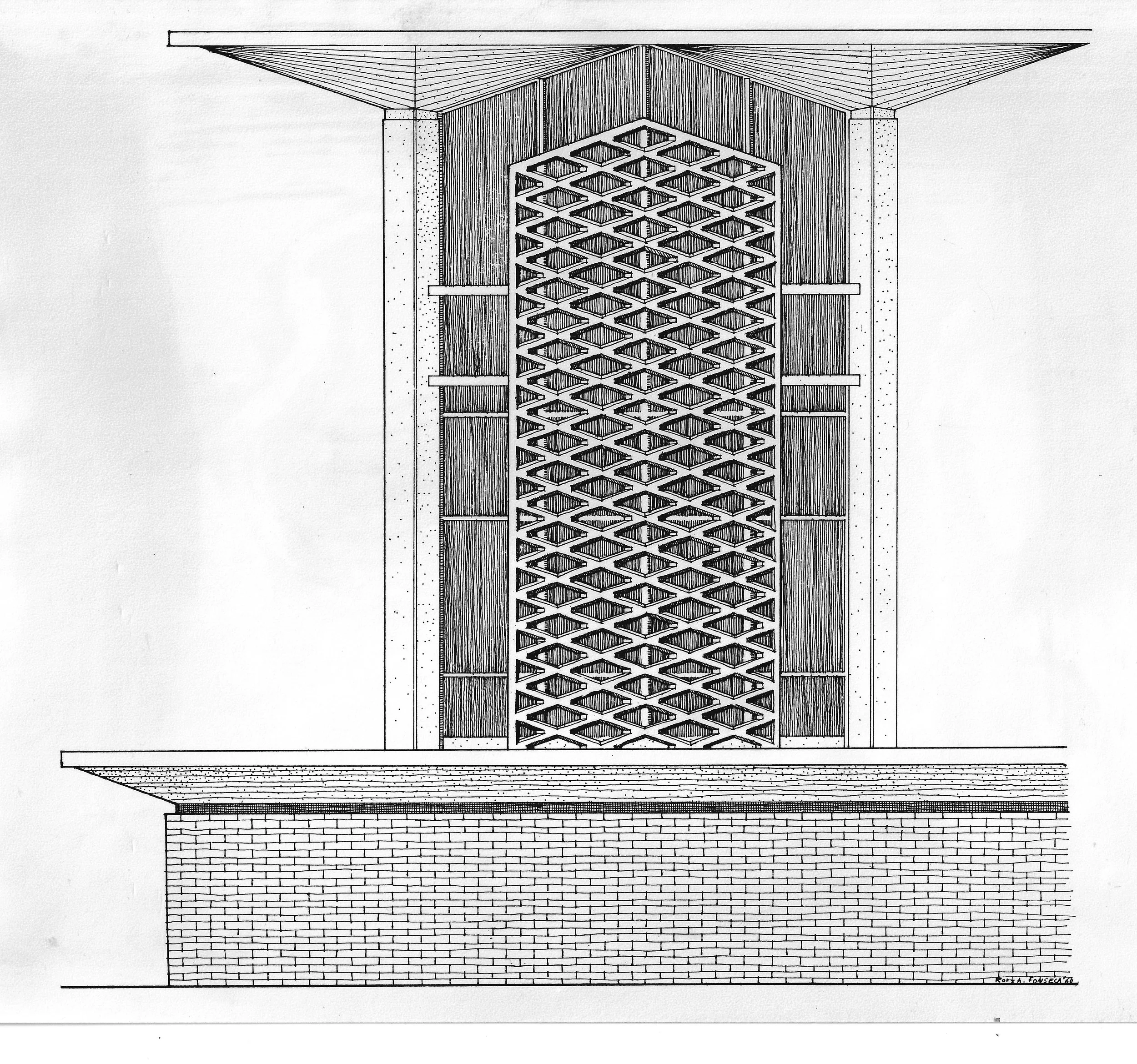
College of San Mateo Library Screen Detail. Rory A. Fonseca, 1960. Courtesy of Warnecke Architectural Archives.
Holistic Design Across the Campus
The campus design becomes most compelling where the site-planning decisions intersect with Warnecke’s architectural language, so that terraces, courtyards, and buildings follow the same underlying clarity and read together as a single, unified composition.
As you move through the campus, the cohesiveness of Warnecke’s vision becomes apparent. No two buildings are identical, yet they clearly belong to the same family: they share materials, proportions, and recurring structural motifs.
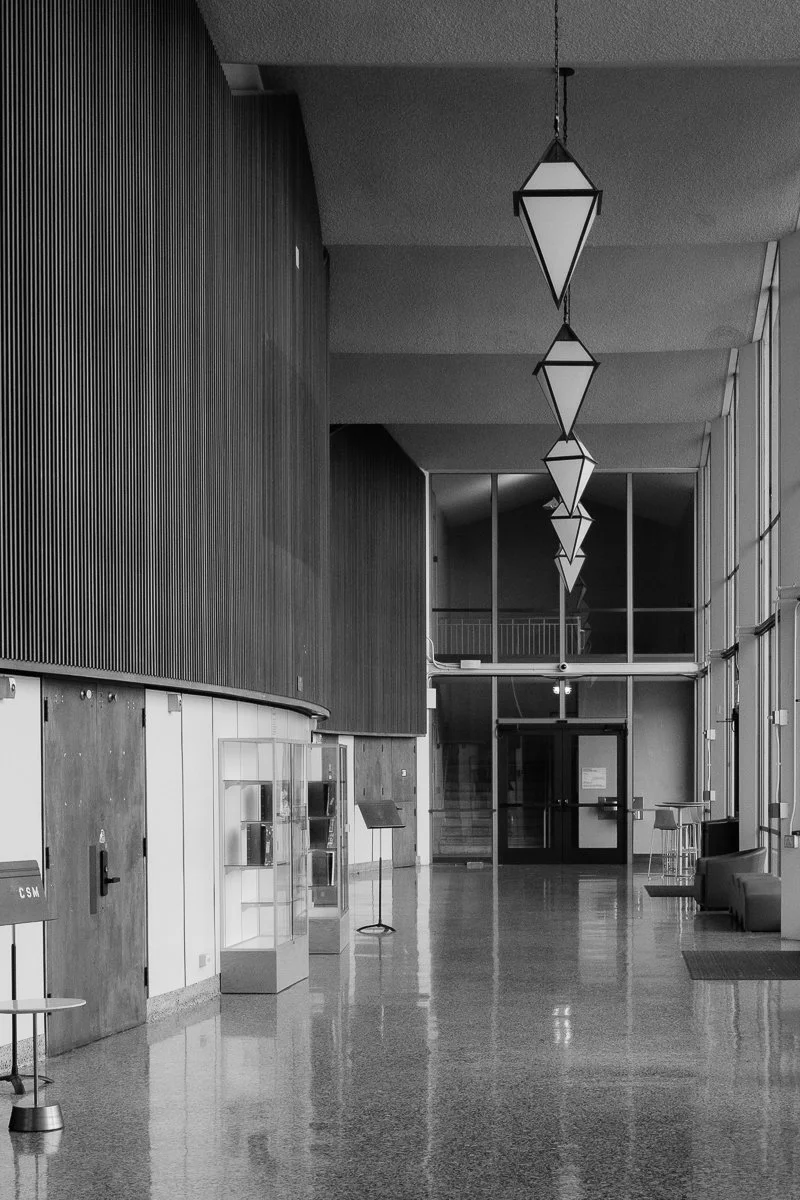
Lobby of the College of San Mateo Theater (building 3).
A Campus Transformed
Over the decades, the College of San Mateo has gradually modernized and removed almost half of the original buildings, yet Warnecke’s underlying design principles continue to shape how the campus is experienced. The first set of changes involved accessibility upgrades that reworked circulation routes and added elevators and ramps, and regraded terraces so people of all abilities can move comfortably across the campus.
Later, as the school adapted to changing academic programs and technologies, fifteen Warnecke buildings were torn down and replaced by the College Center, Science Building, and Health & Wellness Building, whose careful siting and restrained forms keep them from overwhelming the character of the 1963 campus.
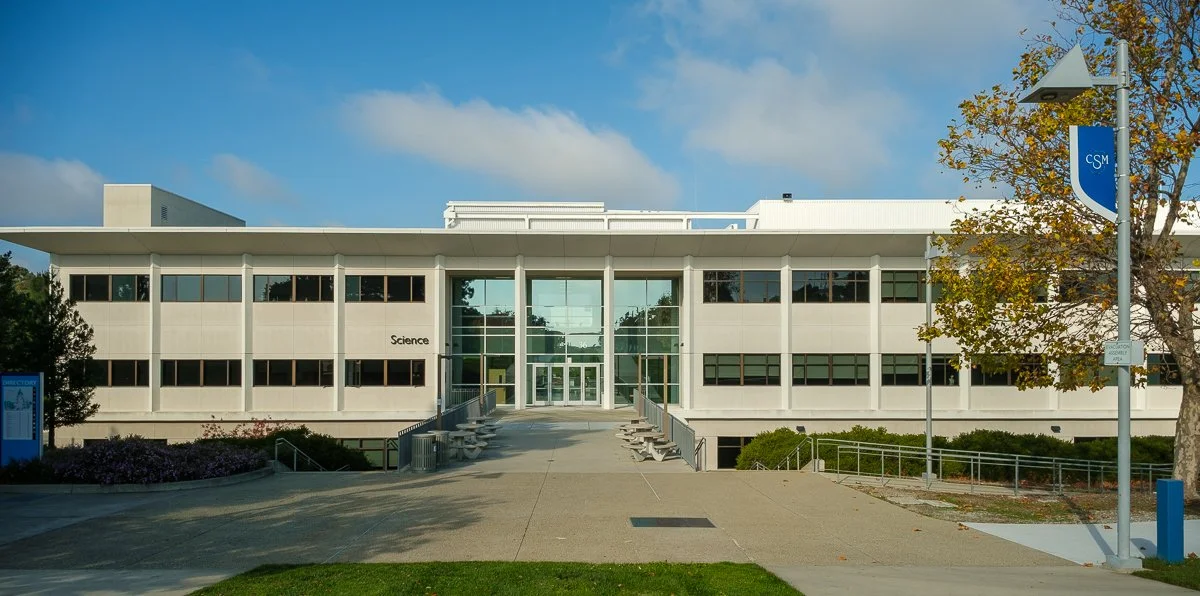
College of San Mateo Science Center (building 36). Architect: LPA Inc., 2006.
When the Science Building—the first of the major new buildings on campus—was planned, the approach was to treat the campus as having a single architectural language to be extended rather than replaced. The Request for Proposals (RFP) explicitly required that the new building “complement and harmonize with the sculptural character of the existing architecture” and “make reference to the vocabulary of the existing architecture designed by John Carl Warnecke,” That intent is clearly reflected in the finished building: its long horizontal façade and tall, narrow vertical elements echo the proportions and rhythms of the original campus structures without competing with them.
The Architectural Significance of the Surviving Campus
Despite accessibility upgrades, landscape changes, and the addition of new facilities, the architectural DNA of College Heights remains strikingly intact. The surviving Warnecke buildings still convey the calm order, rhythm, and coherence that defined the 1963 Master Plan. Each contributes something essential—the cadence of the vertical bays, the geometry of the folded roofs, the way a building anchors a terrace or frames a walkway. Together, they sustain the experience of a unified mid-century campus rather than a collection of unrelated structures.
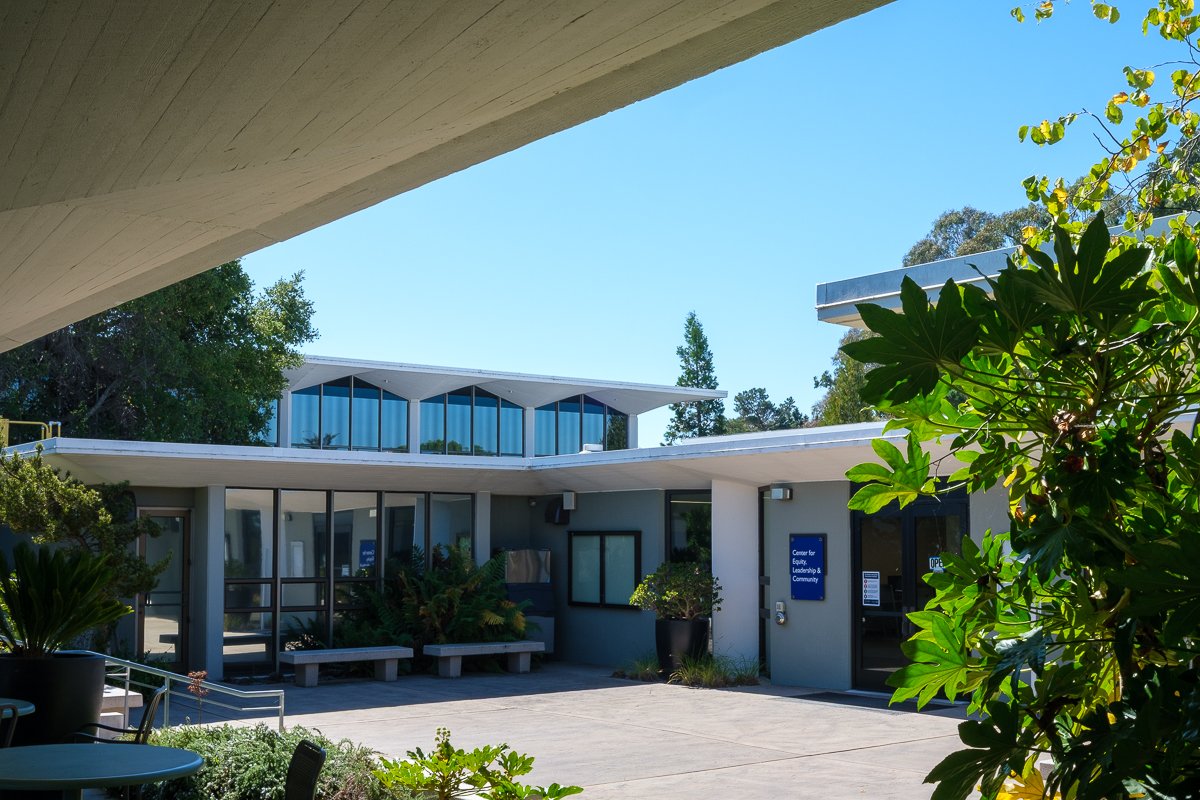
College of San Mateo Center for Equity, Leadership & Community (building 17) and Central Hall (building 16).
In 2011, architectural historian Dana E. Supernowicz noted that the campus “still retains a strong sense of architectural continuity from the 1960s,” concluding that the surviving 1962–63 (sic.) buildings appear to function as contributing elements of a potential National Register–eligible historic district.
Architecture can become a powerful part of an institution’s identity, especially when a campus has a strong, cohesive design. At College Heights, the rooflines, colonnades, and repeating structural rhythms already offer a clear visual language that could anchor interpretation, storytelling, and even branding, giving the college a distinctive architectural presence that echoes Bortolazzo’s belief that design should express the aspirations and purpose of a public institution.
Warnecke’s mid-century buildings are now more than sixty years old and, like similar structures nationwide, face the combined pressures of age, changing educational needs, new codes, and rising maintenance costs; yet a remarkable number of the original buildings still stand, function, and remain freely accessible. Architectural historians have described the surviving ensemble as among Warnecke’s finest works. Recent planning documents contemplate replacing several 1963 buildings, including the Library, which the current master plan itself calls “an iconic building… that defines the campus character.”
For anyone who cares about architecture or local history, this is the moment to walk the campus: the Fine Arts Center still reads as a sculptural ensemble, the Library Terrace still commands the principal axial view, and the colonnades, terraces, glass walls, and long sightlines continue to communicate the clarity of the original design.
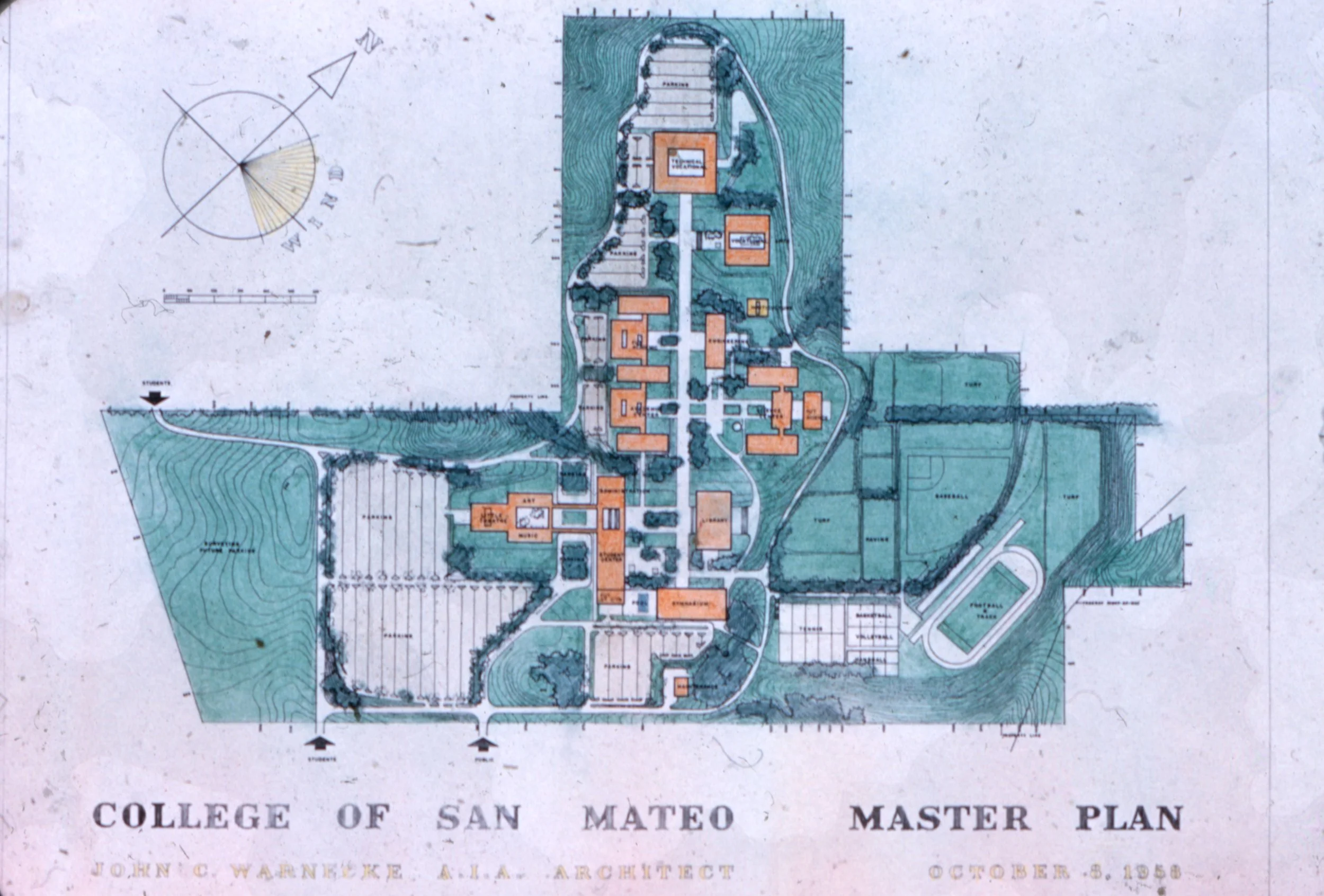
College of San Mateo Master Plan Drawing, October 1958. Courtesy of Warnecke Architectural Archives.
CSM Today
Today, College Heights is still a thriving campus, with many of Warnecke’s buildings serving their original purpose. It is also still doing what Bortoloz and Warnecke intended: projecting dignity, aspiration, and academic purpose.
The College of San Mateo continues to open pathways and opportunities for many different people, putting higher education within reach of anyone who wants it. This book is dedicated to Dr. Manuel Alejandro Pérez, President of CSM — warmly known as “the Pérezidente” — for his leadership and the warmth he brings to the college. It is also dedicated to the faculty, staff, and administrators who make CSM’s mission a reality.
Original Building Inventory
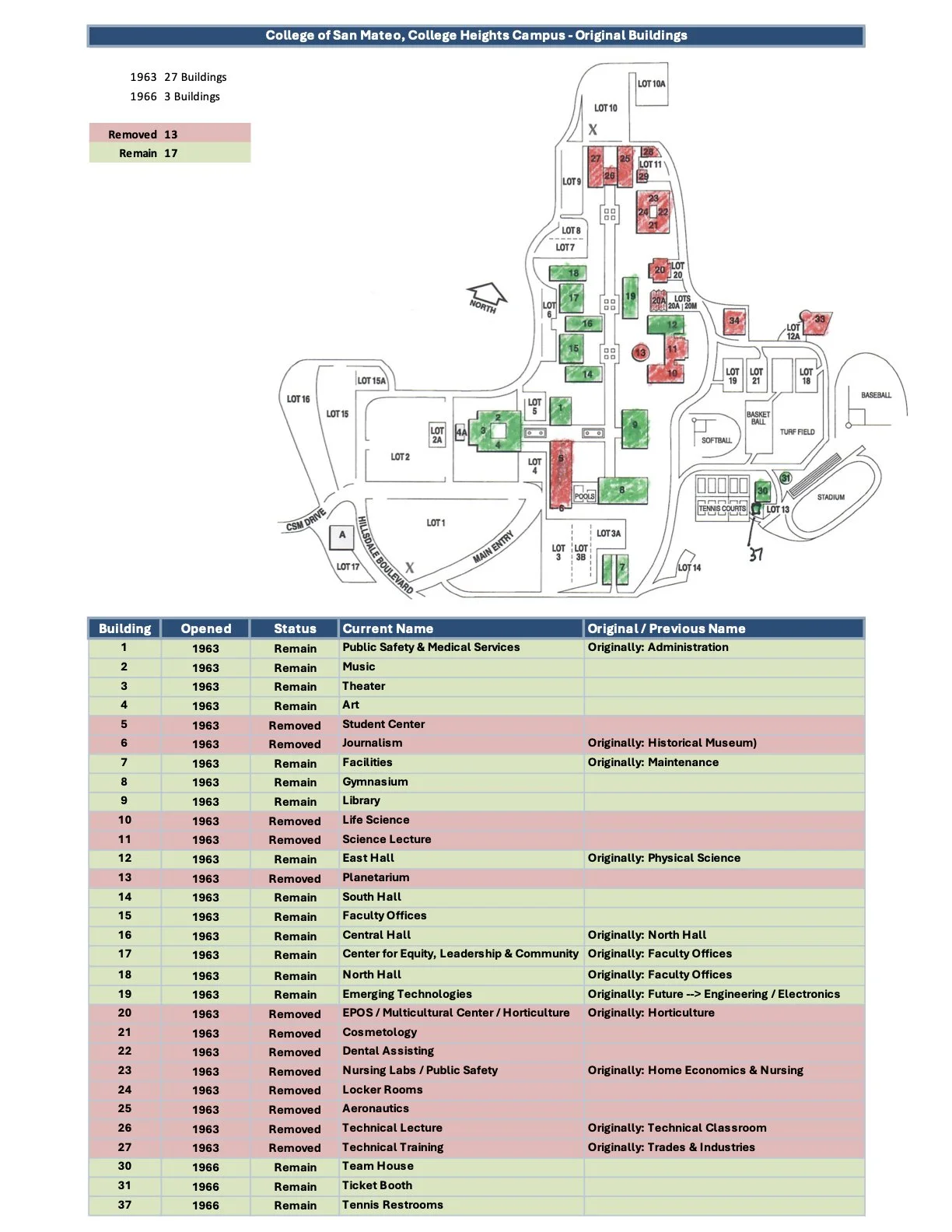
-
1950
Need for a new campus recognized
1954
San Mateo Junior College was renamed to College of San Mateo
John Carl Warnecke contracted to conduct site studies
1956
Dr. Bortolazzo becomes president of the College of San Mateo
1957
Decision to fund and build a new campus
College Heights location selected
Design process started
1958
Master plan approved
1960
Groundbreaking (January)
Grading and site preparation work begin.
1961
Construction of buildings begins (February)
1962
Planned completion date (September)
1963
First classes held at new Campus (September 30)
Library opens (November 15)
Official dedication (December 8)
-
John Carl Warnecke (1919–2010) was one of the most important American architects working in the mid-20th century, even if his name is not widely known outside architecture circles.
Based in San Francisco, he became known for what later came to be called contextual architecture: the idea that a building should respond to its natural, historic, and cultural setting rather than ignore it. That approach helped distinguish him from more rigid forms of modernism.
Over the course of his career, Warnecke designed or planned hundreds of projects, ranging from schools and colleges to airports, embassies, civic buildings, and government complexes. His best-known works include the Hawaii State Capitol, the restoration of Lafayette Square across from the White House, and President John F. Kennedy’s memorial gravesite at Arlington National Cemetery.
Warnecke also left a major imprint on the Bay Area and Northern California. His local work included the College of San Mateo campus, the master plan for UC Santa Cruz, Moffitt Library at UC Berkeley, multiple buildings at Stanford University, including the post office and bookstore, Mira Vista Elementary School in Richmond, expansion of Asilomar Conference Grounds in Pacific Grove, and projects for San Francisco International Airport and Metropolitan Oakland International Airport.
By the time he designed the College of San Mateo in the late 1950s, Warnecke was already an internationally recognized architect. At CSM, his sensitivity to landscape, climate, views, and movement through space came together in one of the most ambitious and distinctive community college campuses of its era.
The archives of John Carl Warnecke’s architectural work, along with the work of his father, Carl I. Warnecke, are housed at the Warnecke Ranch in Sonoma County, California.
The Warnecke Architectural Archives is also preparing John Carl Warnecke’s memoir, Camelot’s Architect: Life, Modern Architecture and the Kennedys. More information is available at: warneckearchives.com/camelots-architect
-
Architect: John Carl Warnecke
Warnecke Staff: Rory A. Fonseca
Rory, an architect at John Cal Warnecke & Associates drew the renderings of the Library screens. His full role on the project is being researched. No additional records have been located yet to indicate who else at the firm worked on the design.Landscape architect: Michael Painter
Consulting landscape architects: Royston, Hanamoto & Mayes
Structural engineers: John A. Blume & Associates
Mechanical and electrical engineers: Keller & Gannon
Acoustical engineer: Dariel Fitzroy
Climatological consultant: Fowler S. Duckworth
Theater consultant: Paul Landry
Kitchen consultant: Flambert & Flambert
Phase I general contractor: Theo G. Meyers
Phase II general contractor:The Pacific Company
Designer: No records have been located to indicate who else at John Carl Warnecke & Associates worked on the design of the campus.
-
New Formalism emerged in the United States in the mid-1950s as a Modern interpretation of Classicism and as a reaction against the starkness and rigid orthodoxy of the International Style. It kept modern materials and construction methods, but brought back symmetry, columns and colonnades, arches, prestige materials, and a more ceremonial, monumental sense of architecture.
Among the best-known examples of New Formalism are Edward Durell Stone’s U.S. Embassy in New Delhi (1955–58), Lincoln Center for the Performing Arts in New York (developed in the early 1960s), and John Carl Warnecke’s Hawaii State Capitol in Honolulu (1965–69).
The style was especially well-suited to civic, cultural, institutional, and public-facing buildings, where architects wanted modern buildings to feel dignified, composed, and visually rich rather than merely functional.
In many cases, New Formalist buildings also use plazas, fountains, podiums, patterned screens, and carefully organized spatial hierarchies to create an elevated and formal architectural presence.  
Characteristics/criteria of New Formalism
Modern interpretation of Classical, and sometimes Gothic, precedents
Strong symmetry, often strict symmetry
Monumental or at least deliberately formal massing
Flat, often projecting roof planes or heavy roof slabs
Smooth wall surfaces
Columns, colonnades, arcades, or expressed arches
Columns often slender or attenuated
Use of prestige materials such as travertine, marble, granite, or convincing substitutes
Frequent use of podiums or raised platforms
Ornament is restrained but real, not absent
Ornament may include patterned screens, grilles, mosaics, murals, gold trim, or decorative concrete
Formal site planning, often with plazas, fountains, pools, sculpture, or other designed landscape elements
Sometimes uses concrete in expressive forms such as folded plates, waffle slabs, or umbrella shells
Most commonly associated with civic, cultural, institutional, educational, and bank buildings rather than houses or infrastructure  
Surprisingly, there still is not a tremendous amount written about New Formalism compared with many other mid-century styles.
A few good places to start are William H. Jordy’s 1960 essay “The Formal Image,” Marcus Whiffen’s American Architecture Since 1780: A Guide to the Styles, the San Francisco Planning Department’s 2011 and 2024 historic context statements, and the Washington State Department of Archaeology & Historic Preservation’s guides to Mid-Century Modern architecture and New Formalism, which are especially useful for their clear descriptions of the style’s recurring features.
Note on Images:
Images not created by the author are the property of their respective rights holders and are used with permission or under fair use.
In some contemporary photographs, minor visual obstructions, such as HVAC units, alarm boxes, and similar elements, have been digitally removed to make the underlying architecture more visible. This particularly applies to the pictures of the Emerging Technologies building, Library, and Gymnasium in the “Bays, Columns, and the Rhythm of the Facades” section. Original, unaltered files are available upon request for documentation purposes.
-
My first thanks go to Kevin H. Souza of Docomomo. Early in my research, I reached out to him about a CSM article that had disappeared from the Docomomo website and mentioned that I was researching the campus. His reply included a brief line that proved far more consequential than he may have intended: “We would be happy to consider publishing your post as a feature on our website pending review.” That sentence helped shift this project from a personal learning exercise into a writing project. His editorial guidance later helped shape this article as well.
I also want to thank Leni Matthews, Maria Del Real Navarro, and Stephanie Roach at the College of San Mateo archives and library. Their help with archival materials showed me that there was far more history and documentation beneath the surface than I had first realized, and their guidance opened important paths for this research.
A special thanks as well to Michael Svanevik, author of Class Act: College of San Mateo: A History. His book was an essential resource throughout this project, and my conversations with him added valuable information, encouragement, and inspiration.
Paul V. Turner’s lecture on John Carl Warnecke’s life and career helped me recognize the importance of the Warnecke archives and led me to Margo Warnecke Merck and Alice Warnecke Sutro, whose generosity, encouragement, and willingness to open those archives were enormously important to this work.
Architectural historian Dana E. Supernowicz’s 2011 Historic Resources Technical Report was an essential early guide to understanding the architectural and historic significance of Warnecke’s surviving buildings at CSM. More broadly, this project has reminded me how much later research depends on the careful, sometimes under-recognized work of architectural historians and historic-resource professionals who prepare environmental impact reports, historic evaluations, and preservation documents. Dana and all the others have my appreciation.
My thanks also go to Heather M. David, author of Mid-Century by the Bay, whose enthusiasm for the architecture of the College of San Mateo was deeply affirming. She helped me feel that I was not alone in seeing how remarkable this campus is, and she pointed me toward an amazing community of architectural historians who offered information, critique, and encouragement, including Alan Hess, Pierluigi Serraino, and David Weinstein.
I also want to thank Barrett Reiter of Docomomo, whose comments, edits, and advice were invaluable in shaping the final article. She brought a professional architectural historian’s eye to the project and helped make the piece more precise, more grounded, and ultimately stronger.
I owe special thanks to Nico van Dongen, my photography professor, for his continuing enthusiasm and encouragement, and for drawing me back to the campus again and again with my camera. His classes first brought me there, but it was because I kept returning—often to help with later semesters—that I began to photograph the campus more seriously and to see it more deeply.
Finally, my deepest personal thanks go to my wife, Sharon, whose support never wavered even when this project began to look suspiciously like a second full-time job, and to my sons, Zack and Jacob, who have patiently endured many conversations about the campus and more than a few photographs of it.
-
Core Sources on College of San Mateo History
Svanevik, Michael, and Shirley Burgett. Class Act: College of San Mateo: A History. San Francisco: Custom & Limited Editions, 1996.
The standard published history of the College of San Mateo, with coverage of the College Heights campus, Julio Bortolazzo’s leadership, the site-selection process, the 1963 opening of the new campus, and Warnecke’s role in the project.
College of San Mateo. “Building College Heights.” CSM Centennial. Accessed April 29, 2026. available online.
Connects Warnecke, Bortolazzo, classical learning, formal axes, reflecting pools, columnar bays, and the idea that the campus architecture expressed the college’s educational ambitions.
Architecture, Planning, and Historic Resource Documents
ICF International. San Mateo County Community College District 2015 Facilities Master Plan Amendment Draft Environmental Impact Report. San Francisco: ICF International, prepared for San Mateo County Community College District, August 2015. available online.
Section 3.4, “Cultural Resources,” discusses campus history, Warnecke’s design, Neo-Formalism, surviving buildings, campus integrity, and historic-district eligibility.
Supernowicz, Dana E., Historic Resource Associates. “College of San Mateo Fine and Performing Arts Building.” California Department of Parks and Recreation Primary Record and Building, Structure, and Object Record, Primary # P-41-002284. June 2011. In Appendix D, “Cultural Resources Background Information and Documentation,” of ICF International, San Mateo County Community College District 2015 Facilities Master Plan Amendment Final Environmental Impact Report. San Francisco: ICF International, prepared for San Mateo County Community College District, November 2015. available online.
Describes the Fine and Performing Arts Building and related early campus buildings and argues that they contribute to a potential historic district.
ICF. San Mateo County Community College District Districtwide Student Housing at College of San Mateo Project Environmental Impact Report Addendum. San Francisco: ICF, prepared for San Mateo County Community College District, October 2024. available online.
Section 4.4.1 updates the campus cultural resources setting, identifies the CSM Campus Historic District, Fine Arts Complex, and Library as historical resources, and outlines the character-defining features.
Swinerton Builders. College of San Mateo CSM #36 Science Building Integrated Science Center Request for Proposals. ASC Competition 2012. San Mateo, CA: College of San Mateo, 2012. available online.
Shows how later campus work was expected to relate to Warnecke’s original architecture, including references to the campus’s “single vocabulary” and the colonnade.
Archival and Original Campus Planning Documents
College of San Mateo. College Heights Campus. San Mateo, CA: College of San Mateo, ca. 1963. Scanned copy from the College of San Mateo Archives and the John Carl Warnecke Architectural Archives.
Includes an early campus map, building descriptions, planning history, campus costs, and a concise explanation of the architectural strategy.
San Mateo Junior College District. Master Plan for Facilities and Services, 1961–1971. Approved by the Board of Trustees, November 29, 1961. San Mateo, CA: San Mateo Junior College District, 1961. Scanned copy from the College of San Mateo Archives.
Documents district growth projections, facilities planning, site planning, and the original planning logic of the College Heights campus.
John Carl Warnecke & Associates. “The College of San Mateo.” Undated architectural narrative, likely prepared for a campus presentation or groundbreaking-related event. Scan from the John Carl Warnecke Architectural Archives.
Explains the site search, Bortolazzo’s role, faculty committees, educational programming, circulation axes, perimeter roads, parking, microclimate studies, and the aim of creating a mature collegiate atmosphere.
John Carl Warnecke & Associates. “San Mateo Junior College, San Mateo, California.” Undated architectural description. Scan from the John Carl Warnecke Architectural Archives.
Describes the 27-building campus, the 16-foot module, colonnaded courts, roof forms, circulation malls, the Library as a focal point, and the effort to create a collegiate rather than secondary-school atmosphere.
John Carl Warnecke & Associates. “Fact Sheet: College of San Mateo, ‘College Heights’ Campus.” Undated fact sheet. Scan from the John Carl Warnecke Architectural Archives.
Identifies the project scope, consultants, contractors, cost, site, campus design system, building summaries, and chronology through occupancy in September 1963.
John Carl Warnecke & Associates. “Chronological History of the College of San Mateo.” January 11, 1961. Scan from the John Carl Warnecke Architectural Archives.
Traces the planning process from 1950 through site studies, Warnecke’s selection, faculty programming, master planning, grading, and anticipated bidding and move-in dates.
Published Articles and Contemporary Coverage
“A New Campus: The Plan vs. The Architecture.” Progressive Architecture, April 1965, 190–195.
Analyzes the relationship between the campus plan and the architecture soon after the campus opened.
“Colonnaded Courts Set Scale for Junior College Campus.” Pacific Architect & Builder, July 1961.
Discusses the site, module, Spanish and Persian references, colonnaded courts, roof forms, the Library as a focal point, and the perimeter road system.
Bortolazzo, Julio L., and William A. Goss. “A Junior College for All the Community: Case Study: San Mateo (Calif.) Junior College District.” School Progress, July 1965.
Places the College of San Mateo within the district's broader history and mission, including the open-door model, bond measures, multi-campus expansion, and its role as a tuition-free community college.
John Carl Warnecke Background
“An Athletic Architect: John Carl Warnecke.” New York Times, October 7, 1964.
Profiles Warnecke during a period of national prominence and notes his school work, embassy work, Hawaii project, Lafayette Square role, and Kennedy memorial work.
John Carl Warnecke Archive. “John Carl Warnecke Archive (1919–2010).” available online.
Summarizes Warnecke’s education, career, contextual design reputation, and major commissions beyond the College of San Mateo.
Turner, Paul V. John C. Warnecke: Fascinating Life and Architectural Career. Stanford Historical Society program recording, May 19, 2020. Stanford Historical Society Collections, Stanford University Libraries. available online.
Surveys Warnecke’s life, career, contextual architecture, Washington work, and influence on Stanford’s postwar architecture.
-
For a downloadable PDF of this article, updates on future research, articles, and books about John Carl Warnecke and the College of San Mateo, or access to offline research materials, contact Josh Weinberg at josh@weinbergphoto.com or (415) 723-6009.
If you have information, photographs, documents, or memories related to the campus, I’d also welcome hearing from you.
About the Author
Josh Weinberg is a San Francisco–based photographer and photo educator whose work focuses on overlooked urban details and the spaces people pass by without noticing. After a 35-year career in corporate communications and a decade leading historic walking tours with San Francisco City Guides, he turned his attention to photography full-time, bringing a storyteller’s eye to architecture and the built environment.
His interest in the College of San Mateo began as a photography project and grew into a larger effort to understand and document an exceptional mid-century campus.
Josh writes on photography at randomcapture.com. Learn about his photography tours and lessons at weinbergphoto.com. He can be reached at josh@weinbergphoto.com.