
Sea Ranch to North Beach: Encountering Barbara Stauffacher Solomon
By Gary Leung
Barbara Stauffacher Solomon was an accomplished designer and artist known for practicing in a bold Swiss Modernist and Expressionist style.
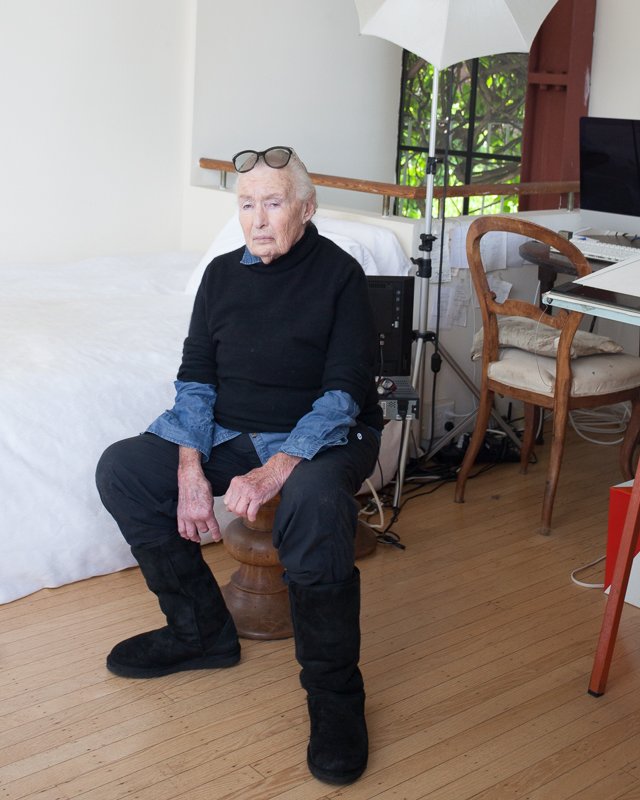
Barbara Stauffacher Solomon. Photograph by Nellie King Solomon; CC BY 4.0
I first met Barbara in 2017, when she graciously invited me over to her home and studio. A few months prior, I posted a photo of her mural during a trip to Sea Ranch. A savvy friend and former employee of William Stout Books commented, “Barbara Stauffacher Solomon!” The name was new to me, which sent me down a research spiral.
I came across her website for Fun Fog Press and reached out to express my admiration. She quickly replied and invited me over.
As I climbed the exterior staircase of her North Beach loft, I was first greeted by her barking dog Gus on the top landing. Barbara called down with a direct, amused authority that matched her Supergraphics—bold, unsentimental, and impossible to ignore. From 15 feet away Barbara had already established herself as a commanding presence.
I had admired her work at Sea Ranch, but my knowledge at that time was admittedly limited. Stepping into her North Beach home, I was immersed in her expansive creative world.
Well recognized for large-scale Supergraphics, Sea Ranch signage, the San Francisco Promenade Ribbon and multiple museum exhibitions. Her work often exuded simplicity, boldness, and play. Her Supergraphics murals melded the supersized exuberance of California Abstract Expressionism—think Clyfford Still, Richard Diebenkorn, and their Bay Area cohort—with hard-edge Swiss graphics. Solomon stated, “It’s said graphic designers simply convey information. No way. No information is simple. It’s impossible to distinguish between information, propaganda, and hype. All meaning is affected by the size, color, weight, and placement of the type; the length of the lines, the width of the columns, the amount of white space, and how each page is designed to inform, conform, deform.”

Strips of Stripes, mural by Barbara Stauffacher Solomon. Photograph by Rob Corder; Flickr.
In a city of so many transplants and transients, I was surprised when she told me she was a third-generation San Franciscan. Born in the Marina District to Lilian “Lil” Reinhertz, a 1920s flapper and piano player, and Fred Levé, a fantastic ballroom dancer and lawyer, she was artistically inclined from the start. Her mother believed a busy daughter stays out of trouble. She studied at the San Francisco Ballet School, was a dancer at the Copacabana in North Beach at age 16, and attended the California School of Fine Arts, where she studied under Nathan Oliveira and David Park. Both would later become key contributors to the Bay Area Figurative movement, a bold shift when Abstract Expressionism was still de rigueur. In 1948, she married experimental filmmaker Frank Stauffacher, brother of modernist printmaker Jack Stauffacher. Frank directed the series “Art in Cinema” at the San Francisco Museum of Modern Art from 1946 to 1954, introducing her to avant-garde circles. My eyes widened as she rattled off the names of her friends—canonized figures in the art world. She partied with the likes of Maya Deren, Hans Richter, Henry Miller, and Man Ray. As Barbara put it, “the ‘let it all hang out’ Sixties began in San Francisco in the late ’40s.”
I could tell she took great pride in her abilities as a dancer as she was quick to share she was not solely a designer. During a notable stint in New York, she danced in a Fall season of the Metropolitan Opera Ballet and took painting classes with Hans Hofmann at the Art Students League. Though soon after, Frank tragically passed away from a brain tumor at age 39, leaving behind Barbara and their daughter Chloe.
In 1956, she studied graphic design as the only American student at the Basel Art Institute in Switzerland under Armin Hofmann, an influential figure of Swiss design. Hofmann is credited with introducing the Swiss style to the United States through his teaching at Yale. Barbara visually characterized him as “looking more like a farmer than a design guru.”
At Basel, Barbara studied sans-serif typefaces “void of decoration and deceit.” The world wars had crumbled the structures of ornamentation, and modernism was a clean slate. She studied handset type with Emil Ruder, who instilled a love for white space. For him, void held an important place in a design composition. These principles remained constant, as she showed me the contemporary drawings, she declared them the result of Swiss training.
In 1958, she stayed with friend Sibyl Moholy Nagy, widow of Bauhaus Professor László Moholy Nagy, in New York City as she looked for design work. She was hired by the George Nelson office to design an exhibition for a mini world’s fair in Moscow. There, she designed propaganda panels highlighting the good life achieved by capitalism.
She returned to San Francisco in 1962 and set up a graphic design studio at 1620 Montgomery St., a building recently purchased by Wurster, Bernardi and Emmons and Lawrence Halprin. Actor Steve McQueen noticed her studio work when using the space as a shooting location for Bullitt. She explained to him, “I learned this stuff in Switzerland. It’s supposed to be strong, the opposite of cute.” During this period, she designed the monthly programs for the San Francisco Museum of Modern Art. At a time when hippies painted squiggly, free, and loose, Solomon’s designs were the antithesis.
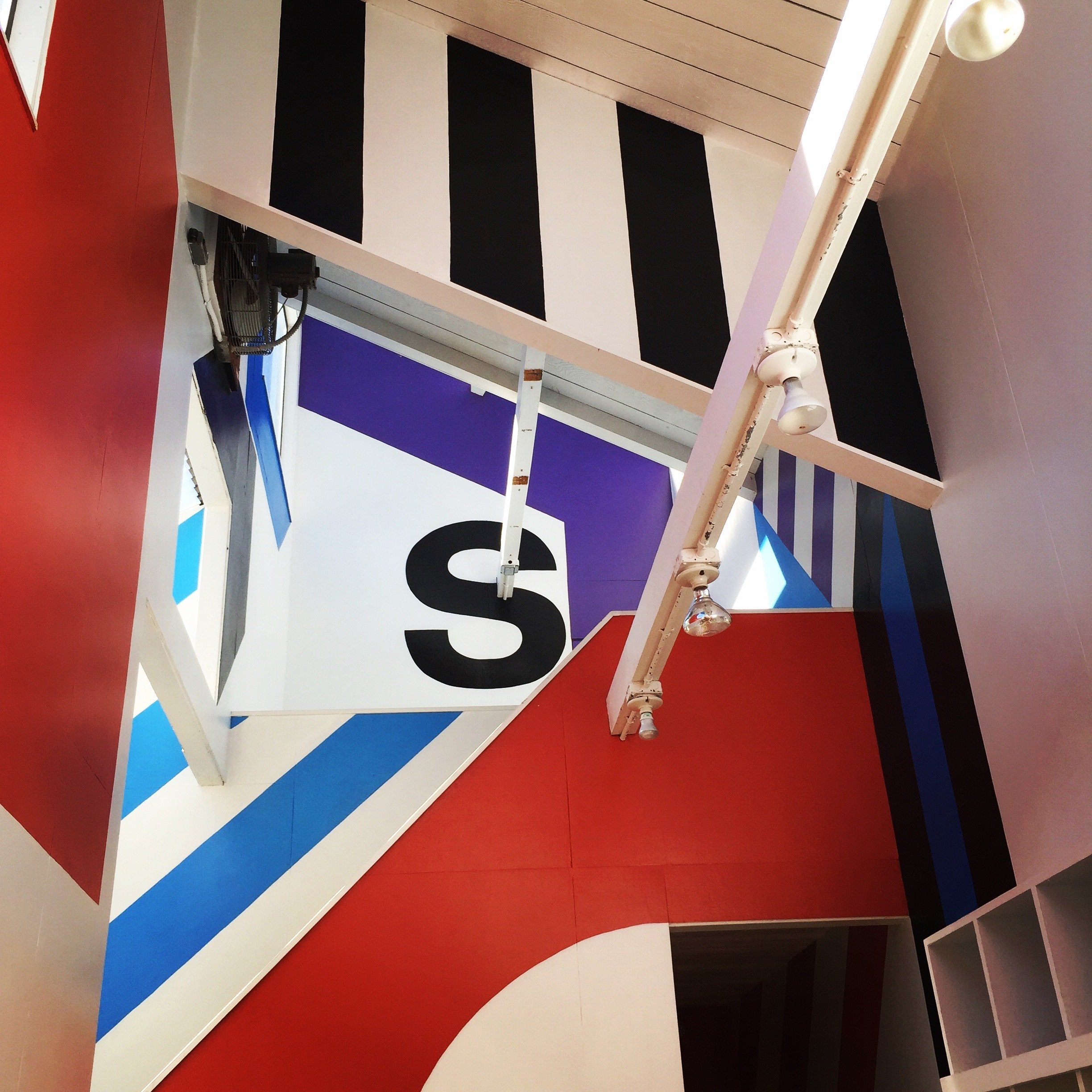
Sea Ranch Supergraphics, designed by Barbara Stauffacher Solomon, 1968. Sea Ranch, Sonoma County, California. Photograph by Gary Leung.
In 1968, landscape architect Lawrence Halprin, a former studio mate of her late husband, employed her to work on Sea Ranch, a condominium development along the coast of Sonoma County with utopian goals of creating a cohesive, private, self-maintaining community. The homes were designed in the Third Bay Tradition by architects such as Esherick, Moore, and Turnbull: vertically expressed, wood shingled, with slanted shed roofs.
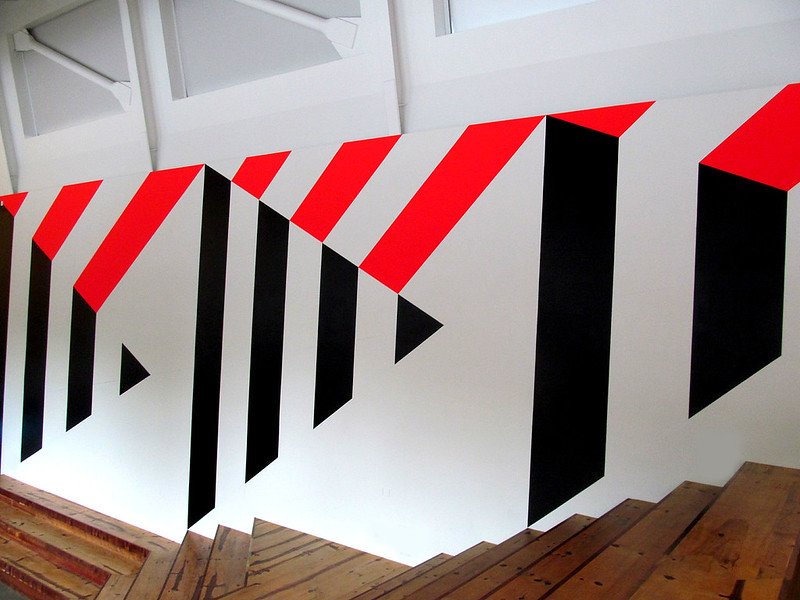
Land(e)scape, Berkeley Art Museum and Pacific Film Archive, Berkeley, California, 2018. Photograph by Rob Corder; Flickr.
As I explored Sea Ranch my eyes darted over Barbara’s signs and murals which swept around the architecture. They create awareness of the space with arrows leading up stairs and stripes wrapping around corners. The locker room murals combined hard-edged geometric renditions of crashing waves, abstracted body parts, and a half heart against a wall that became whole when reflected in the adjacent mirror. She went on to receive two American Institute of Architects awards for the project.
Following the project, she continued to work with Charles Moore and led a design workshop to create graphics within Yale’s Art and Architecture Building.
In 1968, she married architect Daniel Solomon and had a daughter, the artist Nellie King Solomon. Within the shell of a 1890s North Beach home, Daniel Solomon designed a family residence with sash windows and white walls, a Corbusian “machine for living.” It’s no means an ordinary home, when entering, I was overtaken by a drama of vertical space and light punctuated by clerestory windows.
Throughout the ’70s and ’80s, highlights included working for Ricardo Bofill in Barcelona, lecturing at Harvard, and exhibitions with the Walker Art Center, as well as SFMOMA.
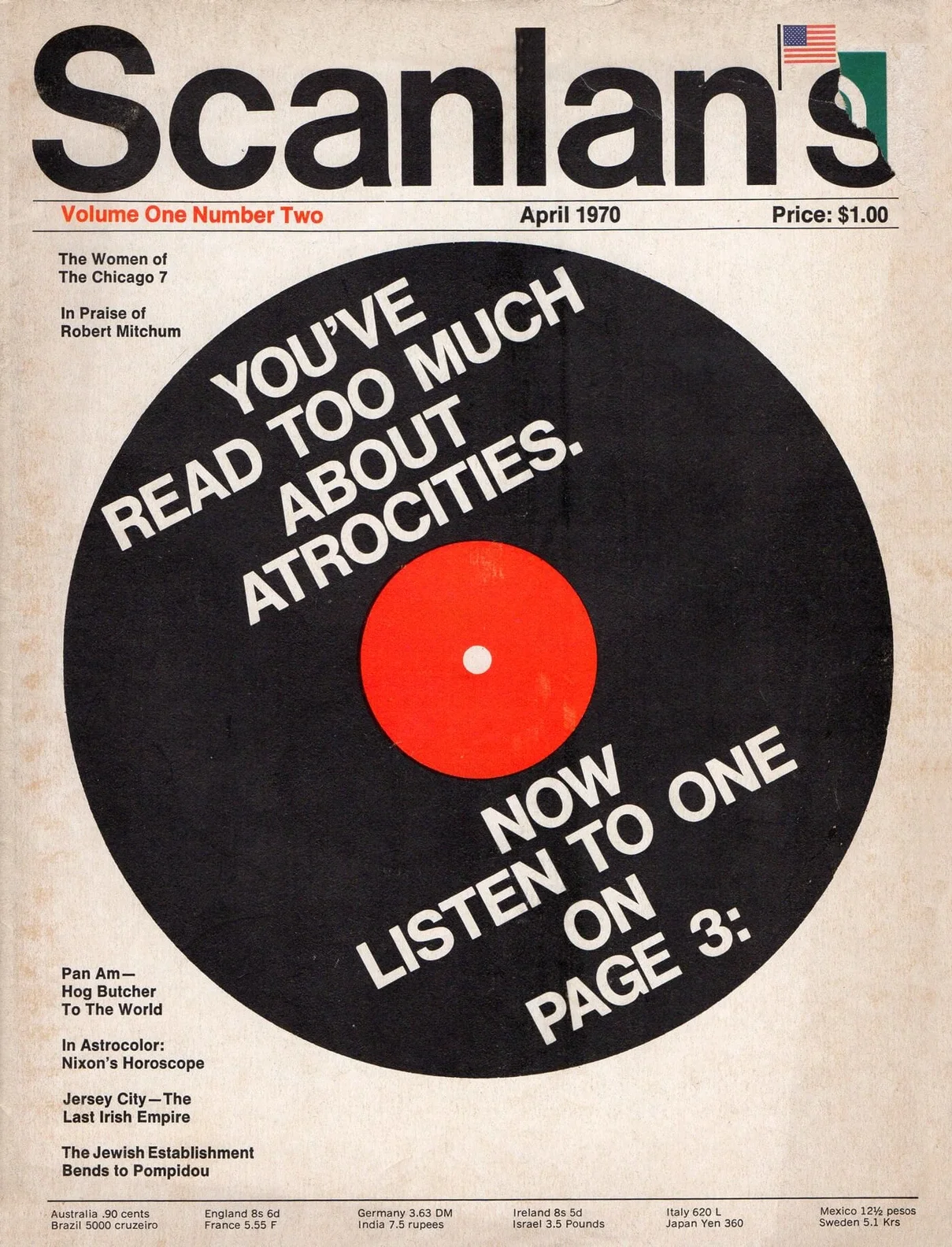
Scanlans Magazine, vol. 1, no. 2. Art direction by Barbara Stauffacher Solomon.
Graduating with a master’s in architecture from Berkeley in 1981, she went on to win a fellowship with the American Academy in Rome in 1983.
In 1990, her redesign of the Tuileries in Paris was selected for the site of I. M. Pei’s glass pyramid entrance to the Louvre. At the elevator to Pei’s office, her collaborators, Louis Benech and Pascal Cribier, informed her that she could not attend the meeting. The French government did not want an American woman on the winning team. She left with an appalled I. M. Pei looking on.
Another high-profile landscape design was the Vesey Green project in 1994, which encompassed a 15,000-square-foot lot in New York’s Battery Park. Barbara humbly stated her proposal was chosen as it was simply “hated less than the others.” The following year, she began a collaboration with Architect Stanley Saitowitz and conceptual artist Vito Acconci on an outdoor art installation for the San Francisco Embarcadero called the Promenade Ribbon. The work was an illuminated succession of glass blocks designed as an “invisible” line evoking both land and water. It spans the entire Embarcadero promenade at 2.5 miles. Unfortunately, the saline bay water has long disabled the lights.
Having served as a member of the San Francisco Art Commission since 2002, she continued to create large-scale graphics, including ones for the Berkeley Art Museum in 2018 and SFMOMA in 2023. The following year, on May 7, 2024, Barbara passed away at age 95, a recognized creative force.

The Promenade Ribbon, San Francisco Embarcadero, 1995. Designed by Barbara Stauffacher Solomon, Stanley Saitowitz, and Vito Acconci. Photograph by Rob Corder; Flickr.
My Afternoon with Barbara in North Beach
Upon entering her home in 2017, I took in the massive library and a mounted painting on the surface of a full-sized ping pong table. She invited me to explore the lofted space and climb a ladder to the roof, where I could enjoy magnificent views of the bay. She explained that she had not been on it in years because of her age, so someone might as well enjoy it.
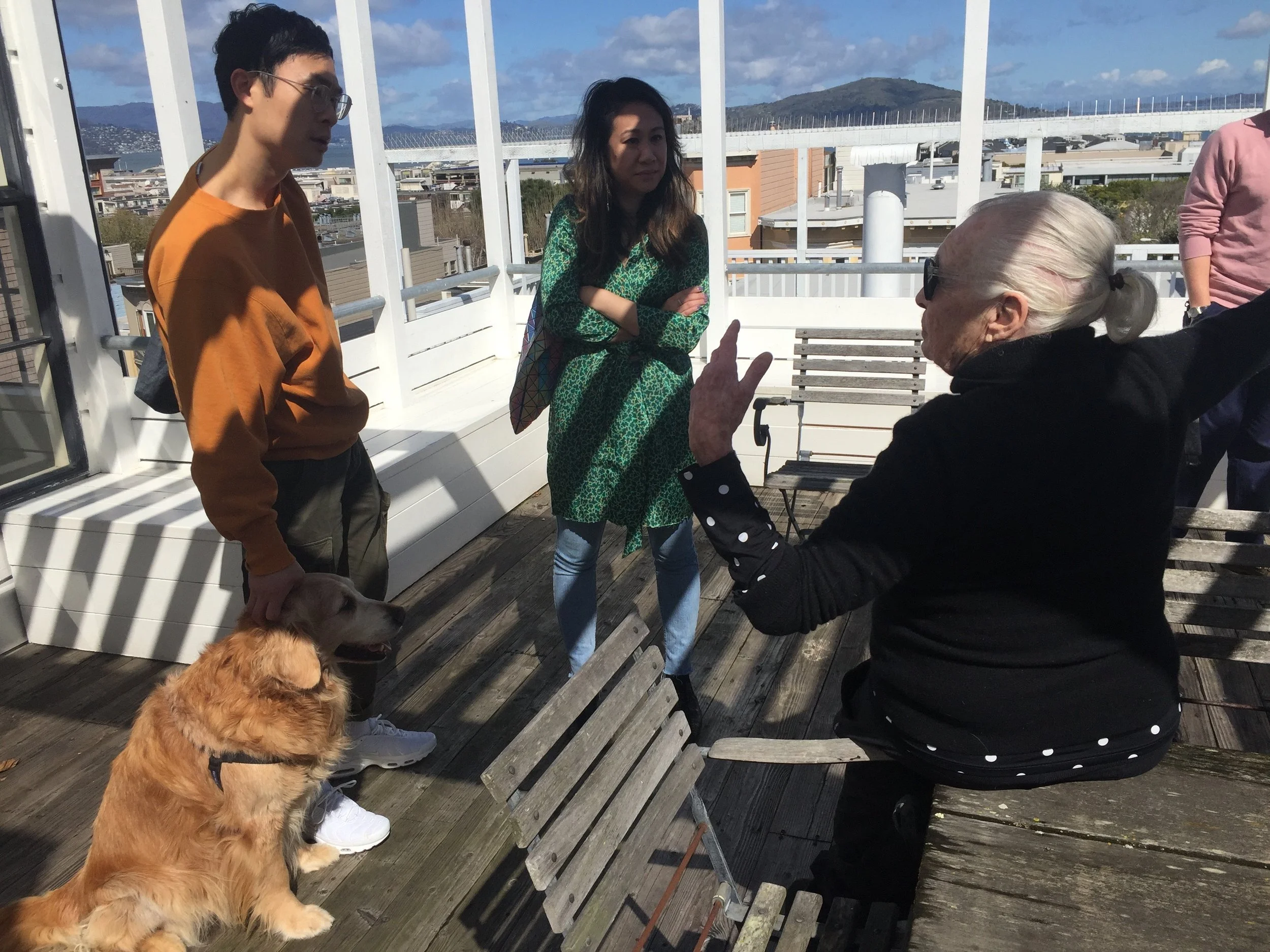
Barbara Stauffacher Solomon's home and studio, North Beach, San Francisco, 2017. Photograph by Gary Leung.
She was direct and self-assured as she spoke. I was intimidated. She captivated me with stories of nights with Surrealists in Paris and dinner with a heavy-drinking Mies van der Rohe in Berlin.
As I sat on a well-loved Corbusier chaise, she took me through portfolios of drawings. She made it clear she wanted them to end up in museums.
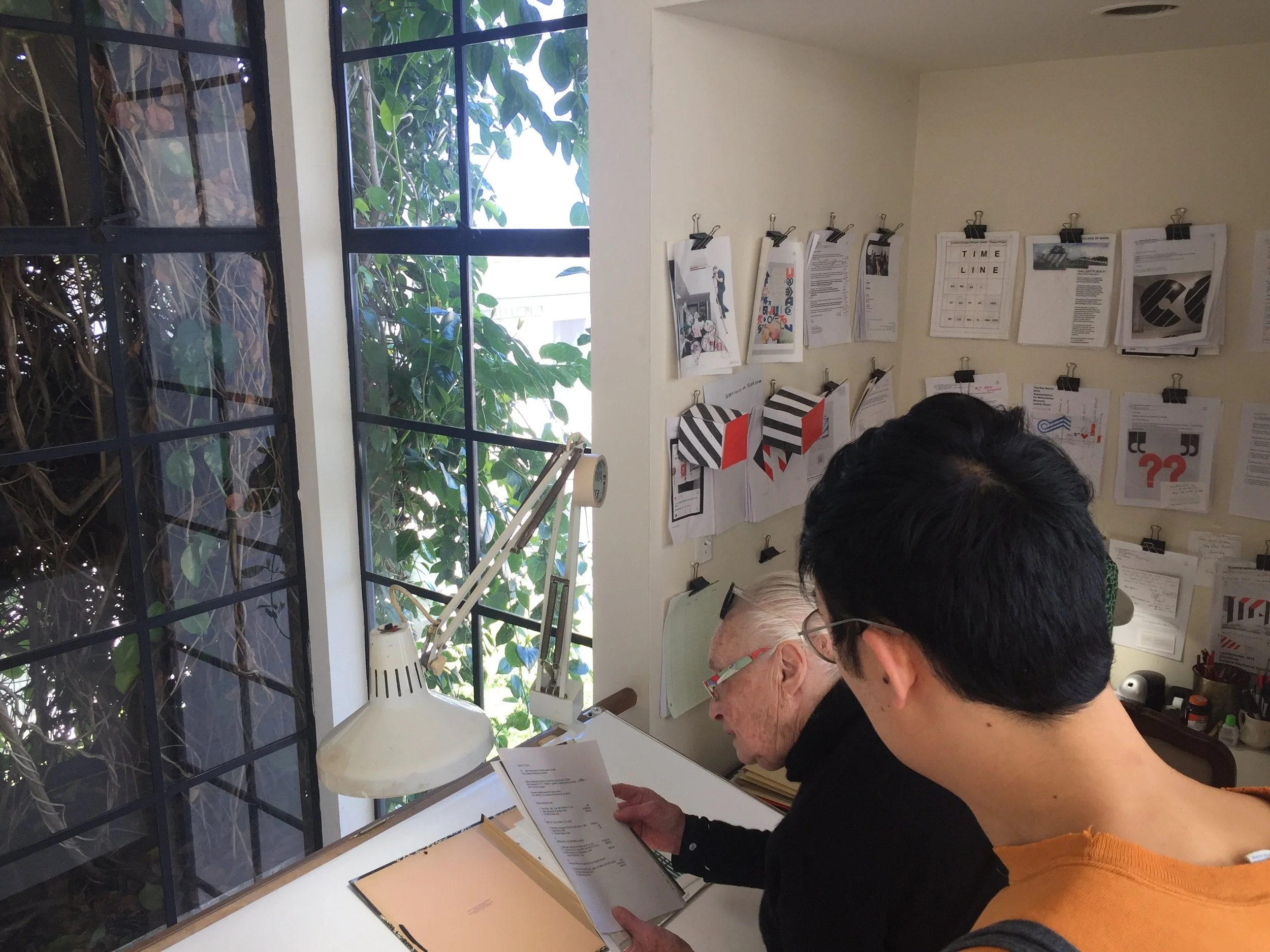
Barbara Stauffacher Solomon's home and studio, North Beach, San Francisco, 2017. Photograph by Gary Leung.
I asked about books and mentioned a recent one featuring her. She snapped back, “Well, are you interested in books about me or by me?”
I purchased copies of her self-published autobiography, Why? Why Not and Green Architecture & The Agrarian Garden, published by Rizzoli. She signed both as “Bobbie,” which she explained was what her friends called her.
I handed over the requested amount in bills, to which she replied, “Good, my dog walker likes cash.”
Gary Leung is often described by his friends and family as the most curious person they know. He always stops to read a plaque. Biking around and taking in the built environment has long been an obsession. After a school friend recommended he read From Bauhaus to Our House by Tom Wolfe, he hasn’t stopped thinking about architecture since.
An avid maker of points-of-interest maps, both local and global, he takes joy in knowing the who, the why, and the when. When traveling, his itineraries are Modernism-focused and have included visits to Bauhaus Dessau, Walden 7, the Reversible Destiny Lofts, and Arcosanti.
When not taking in art and architecture, he volunteers with the eco organization Planet Drum, archives Bay Area counterculture, and hosts a monthly ’90s Simpsons trivia night.