
Portsmouth Square’s Modernist Bridge Demolished
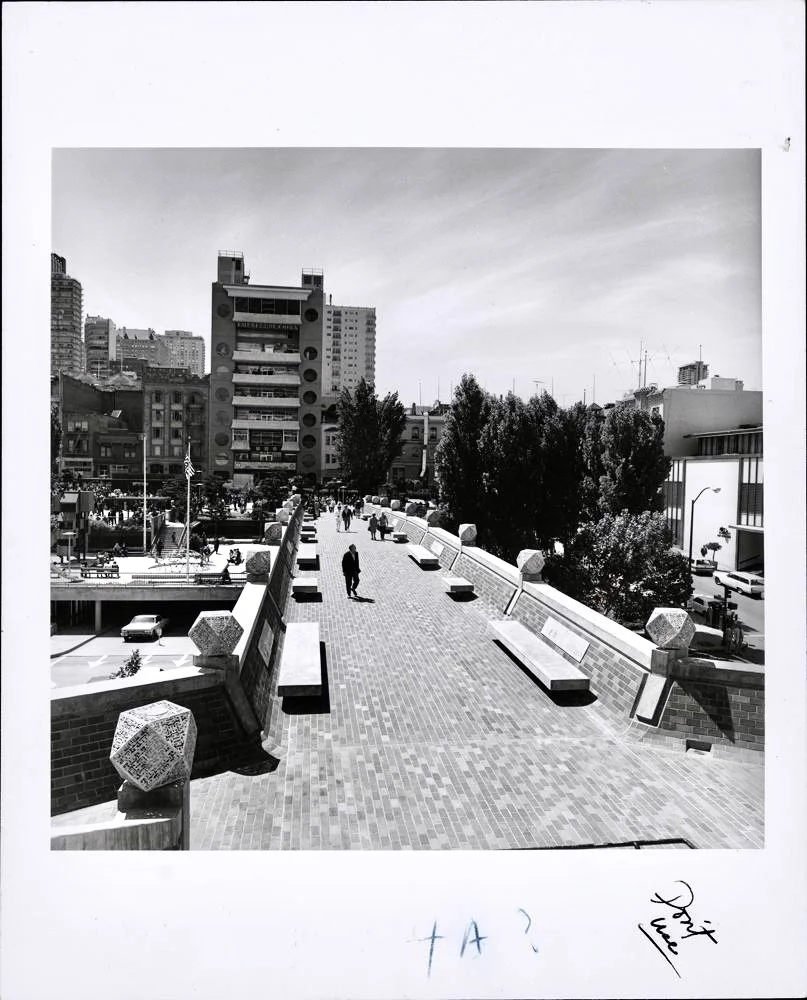
Pedestrian bridge linking Portsmouth Square to the Holiday Inn Financial District over Kearny Street, 1973. Credit: San Francisco Redevelopment Agency Records (SFH 371), San Francisco History Center, San Francisco Public Library; DigitalSF, SFH371-042.
San Francisco has lost another landmark of postwar modernism, the Portsmouth Square Pedestrian Bridge. In early August, the pedestrian bridge on Kearny Street—which linked Portsmouth Square with the Hilton San Francisco Financial District and the Chinese Culture Center—was brought down. This civic structure, officially called the Dr. Rolland and Kathryn Lowe Community Bridge and well known among skateboarders as "China Banks", was a significant architectural and cultural landmark.
The bridge resulted from a collaboration between Chinese American architect Clement Chen, architect Chen Chi-Kwan, and a team that also included John Carl Warnecke. The bridge was designed to link the new hotel development with Chinatown's historic public square. The sculptural concrete walls, red-brick surfaces, deeply set seating, and elevated promenade deliberately avoided typical images of Chinatown, instead representing a self-assured, hybrid Modernism conceived as an infrastructural element with a clear social function.
For more than fifty years, the bridge has been more than just a route over Kearny Street; its wide deck with built-in benches has served as an informal public space where people can rest, eat, read, socialize, and watch the city. The inclined concrete surfaces also created one of the world's most famous street-skating spots, and "China Banks" had a major influence on the design of skateparks elsewhere, becoming a frequent feature in the visual history of skateboarding.
The demolition of the bridge is included in the City's $73 million Portsmouth Square Improvement Project, which aims to provide a bigger clubhouse, new play and meeting areas, better accessibility, and improved park facilities. Yet the demolition involves a considerable loss, for the bridge was the result of an ambitious collaboration between leading Chinese and Chinese American designers and acted as a rare instance of transnational architectural exchange in San Francisco. It also shows how Modernist design can acquire complex civic, cultural, and informal meanings over time. Therefore, the demolition raises a key question for preservation advocates: how can San Francisco revitalize its vital public spaces without overlooking the culturally significant architecture of the recent past?